
Sheet Molding And Bulk Molding Compound Market Size, Share, Trends and Forecast 2035
The Sheet Molding And Bulk Molding Compound Market report is Segmented By Product Type (Sheet Molding Compound) (SMC), Bulk Molding Compound (BMC), By Resin Type(Polyester Resin, Epoxy Resin, Vinyl Ester Resin, Phenolic Resin, Polyurethane Resin, Others) By Fiber Type (Glass Fiber, Carbon Fiber, Natural Fiber, Hybrid Fiber) By Manufacturing Process ( Compression Molding, Injection Molding, Transfer Molding, Resin Transfer Molding, Automated Composite Processing) By End-use Industry (Automotive, Electrical & Electronics, Building & Construction, Aerospace & Defense, Consumer Appliances, Energy & Power, Industrial Equipment)By Distribution Channel(Direct Sales, Distributors, OEM Supply Agreements, Online Industrial Platforms) By Region (North America, Latin America, Europe, Asia Pacific, Middle East, and Africa) - Global Industry Analysis, Size, Share, Growth, Trends, Regional Analysis And Forecast 2026 To 2035
Content
What is the Current Sheet Molding And Bulk Molding Compound Market Size and Share?
The global sheet molding and bulk molding compound market size was valued at USD 5.11 billion in 2025, is estimated to reach USD 5.44 billion in 2026, and is projected to reach USD 9.64 billion by 2035, growing at a CAGR of 6.55% from 2026 to 2035. In terms of volume, the sheet molding and bulk molding compound market is projected to grow from 2.75 million tons in 2025 to 4.81 million tons by 2035. growing at a CAGR of 5.75% from 2026 to 2035. The market includes a segment of high-performance, thermoset fiber-reinforced polymer composites, combining fillers, resins, and glass/carbon fibers to create lightweight, durable, and corrosion-resistant components. These materials are generally used for high-grade molding in the electrical, automotive, and construction sectors.
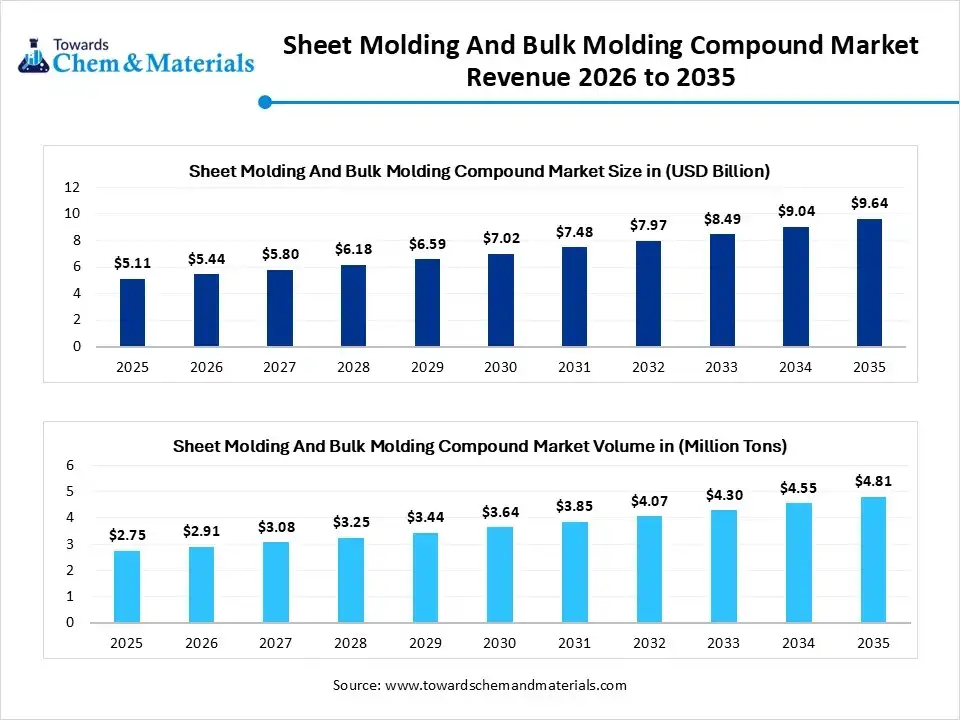
The versatility of these materials enables customization, allowing them to meet specific industry requirements. As industrial sectors evolve, the incorporation of smart technologies into manufacturing processes is expected to enhance production efficiency further. Hence, the market is trending toward a more innovative and sustainable landscape, with firms adapting to address shifting consumer demands and regulatory frameworks. The corporate shift toward sustainable practices necessitates the development of green alternatives, prompting innovations in material science. This transition ensures compliance with emerging environmental regulations and aligns with consumer preferences for sustainable options.
Key Takeaways
- By region, Asia Pacific dominated the market with the largest share of 41% in 2025. The dominance of the region can be attributed to the surge in EV production.
- By region, the Middle East & Africa is expected to grow at the fastest CAGR of 7.80% over the forecast period. The growth of the region can be credited to the ongoing infrastructure expansion.
- By product type, the sheet molding compound (SMC) segment dominated the market with the largest share of 68% in 2025. The dominance of the segment can be attributed to the increasing demand for high-strength composite materials.
- By product type, bulk molding compound (BMC) segment is expected to grow at the fastest CAGR of 5.50% over the forecast period. The growth of the segment can be credited to the rising adoption of molded composite components.
- By resin type, polyester resin segment dominated the market with the largest share of 49% in 2025. The dominance of the segment can be linked to the growing consumption of polyester-based compounds.
- By resin type, polyurethane resin segment is expected to grow at the fastest CAGR of 8.20% over the forecast period. The growth of the segment can be driven by increasing demand for polyurethane composite systems.
- By fiber type, glass fiber segment dominated the market with the largest share of 71% in 2025. The dominance of the segment is due to ongoing expansion and product utilization by the automotive industry.
- By fiber type, carbon fiber segment is expected to grow at the fastest CAGR of 8.90% during the projected period. The growth of the segment can be attributed to the technological innovations in the production process.
- By manufacturing process, compression molding segment dominated the market with the largest share of 58% in 2025. The dominance of the segment can be linked to its superior dimensional accuracy.
- By manufacturing process, automated composite processing segment is expected to grow at the fastest CAGR of 8.60% during the study period. The growth of the segment can be driven by ongoing automation in advanced composite manufacturing technologies.
- By end-use industry, automotive segment dominated the market with the largest share of 39% in 2025. The dominance of the segment is due to the extensive adoption of lightweight molding compounds.
- By end-use industry, aerospace & defense segment is expected to grow at the fastest CAGR of 8.70% during the study period. The growth of the segment can be attributed to the growing adoption of advanced composite materials.
- By distribution channel, direct sales segment dominated the market with the largest share of 44% in 2025. The dominance of the segment can be linked to the major market players increasingly maintaining direct supply agreements with OEM suppliers.
- By distribution channel, online industrial platforms segment is expected to grow at the fastest CAGR of 8.50% during the projected period. The growth of the segment can be driven by its ability to improve pricing transparency.
Market Size and Volume Forecast
- Market Estimated Size (2025): USD 5.11 Billion | CAGR (2026–2035): 6.55%
- Market Projected Size (2035): USD 9.64 Billion
- Asia Pacific: largest Market Revenue Share of 41% in 2025.
- Market Estimated Volume (2025): 2.75 Million Tons | Volume CAGR (2026–2035): 5.75%
- Market Projected Volume (2035): 4.81 Million Tons
- Market Pricing (2025):
- Average Manufacturing Price (2025): USD 2,185/Ton
- Average Selling Price (2025): USD 3,045/Ton
- Pricing CAGR (2026–2035): 3.29%
Sheet Molding And Bulk Molding Compound Market Trends
- Increasing product demand from the automotive sector is the latest trend in the market, shaping positive market growth. As market players are striving to improve fuel efficiency and minimize emissions, the adoption of these compounds is increasingly becoming prevalent.
- The growing focus on sustainability and adherence to stringent regulations is another major factor driving market growth. As governments and organizations are increasingly implementing stringent guidelines to minimize carbon footprints, market players are compelled to adopt sustainable materials and processes.
- Increasing demand for electrification across the globe needs materials with better moisture, chemical, and corrosion resistance. This durability reduces overall maintenance costs for outdoor assets. Moreover, advancements like advanced molding techniques and automated production lines are improving efficiency further.
How Are Cutting-Edge Technologies Revolutionizing the Sheet Molding and Bulk Molding Compound Market?
Advanced technologies are transforming the market by fueling lightweighting, improving structural performance, and allowing Industry 4.0 automation. Key innovations include high-precision compression molding, carbon fiber reinforcement, and digital twins for optimization. Furthermore, market players are using digital twin technologies to optimize and simulate complex molding processes before physical manufacturing, enhancing consistency.
Supply Chain Analysis of the Sheet Molding And Bulk Molding Compound Market
Feedstock Procurement
It involves the strategic sourcing and purchasing of essential materials necessary to manufacture these thermoset composite materials, to make a consistent supply of high-quality raw materials.
- Major Players: IDI Composites International, Menzolit GmbH
Chemical Synthesis and Processing
It refers to the multi-stage, highly controlled chemical formulation and manufacturing workflow. This stage converts raw liquid thermosetting monomers into stable composites.
- Major Players: Continental Structural Plastics / Teijin, Polynt-Reichhold
Packaging and Labelling
It is a crucial stage to maintain the chemical stability and prevent premature curing. Their packaging must act as a total barrier to volatile chemical evaporation and external environmental factors.
- Major Players: Continental Structural Plastics, Core Molding Technologies
Regulatory Compliance and Safety Monitoring
It emphasizes adhering to stringent environmental, emission, and workplace safety standards, especially in the electrical and automotive sectors. Key players are increasingly adopting low-emission and sustainable materials.
- Major Players: Showa Denko, IDI Composites International
Sheet Molding And Bulk Molding Compound Market's Regulatory Landscape: Global Regulations
| Country/Region | Key Regulations |
| European Union (EU) | Styrene Emissions Reduction: The EU Industrial Emissions Directive (IED) mandates a reduction in volatile organic compounds (VOCs). This is actively shifting 30% of regional production away from traditional polyester toward low-emission or epoxy-based SMC. |
| United States | Fire Safety Standards: For electrical components and public transport applications, SMC/BMC formulations must pass UL 94 flammability ratings and ASTM E162/E662 smoke and flame spread testing. |
| India | The Bureau of Indian Standards (BIS) outlines specific structural and mechanical benchmarks for composite products like polymer concrete manhole covers, electrical junction boxes, and transit seating. |
Market Dynamics
Driver
Increasing Emphasis on Lightweight Materials
The growing focus on lightweight materials across different industries is the major factor driving the growth of the market. As companies are aiming to enhance energy efficiency and minimize overall operational costs, the need for lightweight yet robust materials is increasing. This trend is especially pronounced within the aerospace and transportation industries, where mass optimization directly dictates operational performance. The industry is experiencing a fundamental transition, driven by the strategic integration of advanced, high-strength-to-weight compounds to optimize performance and sustainability.
Restraint
High Costs
High costs associated with infrastructure, coupled with growing recycling and complexity issues, are the major factors hindering the growth of the market. Ensuring seamless availability and a diverse product portfolio represents the primary challenge and strategic imperative for market expansion. The implementation of stringent environmental regulations, including EU carbon emissions standards and circular economy objectives, imposes substantial compliance hurdles for the thermoset composite manufacturing sector.
Opportunity
Increasing Adoption in Aerospace Applications
The aerospace industry is heavily using bulk molding and sheet molding compounds due to their high strength and lightweight properties. The demand for composite materials within the aerospace sector is expected to escalate, driven by the imperatives of enhanced fuel efficiency and strict compliance with rigorous safety standards, hence creating significant market expansion opportunities for these advanced compounds. The growing demand for sustainable building materials is accelerating the adoption of advanced composites in the construction sector. Hence, sheet molding and bulk molding compounds are increasingly used due to their superior durability and robust resistance to environmental degradation.
Segmental Insights
Product Type Insights
The Sheet Molding Compound (SMC) Segment Dominated the Market with 68% of Market Share in 2025
The sheet molding compound (SMC) segment dominated the market with the largest share of 68% in 2025. The dominance of the segment can be attributed to the increasing demand for high-strength composite materials and its superior dimensional stability. Electric vehicle battery enclosures and exterior panels fuel smooth SMC adoption.
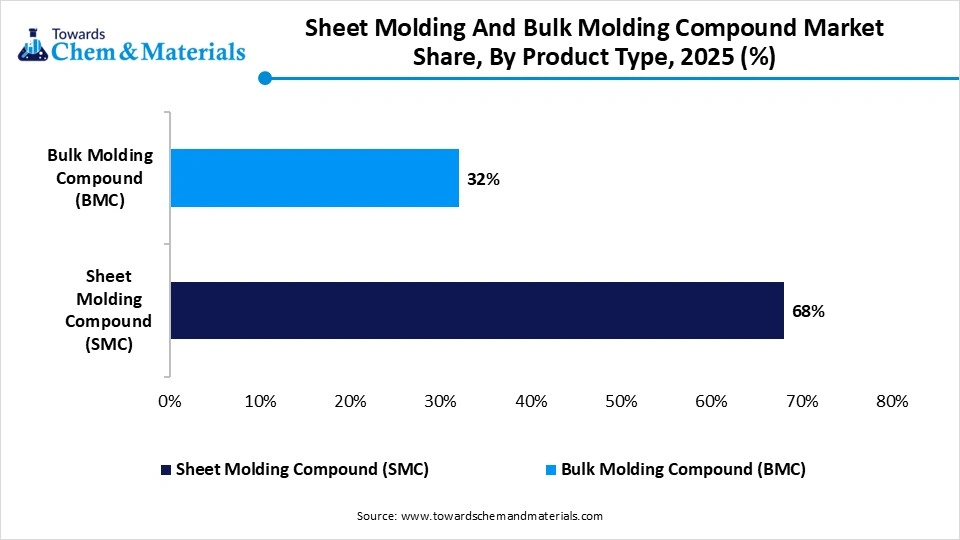
The bulk molding compound (BMC) segment held a market share of 32% in 2025 and is expected to grow at the fastest CAGR of 5.50% over the forecast period. The growth of the segment can be credited to the rising adoption of molded composite components for durability benefits from consumers along with cost-effective processing capabilities. Electrical insulation applications are supporting stable BMC applications globally.
Resin Type Insights
The Polyester Resin Segment Dominated the Market with 49% of Market Share in 2025
The polyester resin segment dominated the market with the largest share of 49% in 2025. The dominance of the segment can be linked to the growing consumption of polyester-based compounds from the automotive and construction sectors along with its cost-effectiveness. Its enhanced thermal and mechanical properties support broader industrial applications.
Sheet Molding And Bulk Molding Compound Market Share, By Resin Type, 2025 (%)
| By Resin Type | Revenue Share, 2025 (%) |
| Polyester Resin | 49% |
| Epoxy Resin | 14% |
| Vinyl Ester Resin | 13% |
| Phenolic Resin | 10% |
| Polyurethane Resin | 8% |
| Others | 6% |
The polyurethane resin segment held a market share of 8% in 2025 and is expected to grow at the fastest CAGR of 8.20% over the forecast period. The growth of the segment can be driven by increasing demand for polyurethane composite systems across the globe and its flexible formulation capabilities. The automotive industry's focus on enhancing fuel efficiency through advanced materials drives segment growth shortly.
The epoxy resin segment held a market share of 14% in 2025. The growth of the segment is owing to the increasing adoption of high-performance epoxy resins across the globe along with its superior chemical resistance and adhesion properties. A rise in demand from EV battery systems boosts segment growth soon.
Fiber Type Insights
The Glass Fiber Segment Dominated the Market with 71% of Market Share in 2025
The glass fiber segment dominated the market with the largest share of 71% in 2025. The dominance of the segment is due to ongoing expansion and product utilization by the automotive and construction industries along with its cost-effectiveness and durability. Moreover, enhanced production scalability promotes much broader industrial penetration.
Sheet Molding And Bulk Molding Compound Market Share, By Fiber Type, 2025 (%)
| By Fiber Type | Revenue Share, 2025 (%) |
| Glass Fiber | 71% |
| Carbon Fiber | 15% |
| Natural Fiber | 8% |
| Hybrid Fiber | 6% |
The carbon fiber segment held a market share of 15% in 2025 and is expected to grow at the fastest CAGR of 8.90% during the projected period. The growth of the segment can be attributed to the technological innovations in the production process and increasing demand for lightweight and high-performance composites. Carbon fiber enhances structural integrity while reducing overall costs.
The natural fiber segment held a market share of 8% in 2025. The growth of the segment can be credited to the increase in consumer preference for sustainable materials and sustainability initiatives encouraging the integration of renewable fibers into composite manufacturing. Automotive interiors are increasingly using bio-based reinforced materials.
Manufacturing Process Insights
The Compression Molding Segment Dominated the Market with 58% of Market Share in 2025
The compression molding segment dominated the market with the largest share of 58% in 2025. The dominance of the segment can be linked to its superior dimensional accuracy and shorter cycle times. High-volume automotive production often depends on efficient compression molding technologies.
Sheet Molding And Bulk Molding Compound Market Share, By Manufacturing Process, 2025 (%)
| By Manufacturing Process | Revenue Share, 2025 (%) |
| Compression Molding | 58% |
| Injection Molding | 18% |
| Transfer Molding | 9% |
| Resin Transfer Molding | 8% |
| Automated Composite Processing | 7% |
The automated composite processing segment held a market share of 7% in 2025 and is expected to grow at the fastest CAGR of 8.60% during the study period. The growth of the segment can be driven by ongoing automation in advanced composite manufacturing technologies along with the production of highly stable EV components. Robotics enhance production precision and reduce material waste substantially.
The injection molding segment held a market share of 18% in 2025. The growth of the segment is owing to the increasing demand for precise molding components from the consumer electronics and appliances industry coupled with a surge in complex geometrical manufacturing. Automated injection systems enhance overall production efficiency.
End-Use Industry Insights
The Automotive Segment Dominated the Market with 39% of Market Share in 2025
The automotive segment dominated the market with the largest share of 39% in 2025. The dominance of the segment is due to the extensive adoption of lightweight molding compounds and safety and thermal management needs. OEMs are rapidly replacing metal components with composites to enhance efficiency.
Sheet Molding And Bulk Molding Compound Market Share, By End-use Industry, 2025 (%)
| By End-use Industry | Revenue Share, 2025 (%) |
| Automotive | 39% |
| Electrical & Electronics | 20% |
| Building & Construction | 14% |
| Aerospace & Defense | 9% |
| Consumer Appliances | 8% |
| Energy & Power | 6% |
| Industrial Equipment | 4% |
The aerospace & defense segment held a market share of 9% in 2025 and is expected to grow at the fastest CAGR of 8.70% during the study period. The growth of the segment can be attributed to the growing adoption of advanced composite materials for aircraft weight reduction and an increase in procurement of durable lightweight materials needing electrical components.
The electrical & electronics segment held a market share of 20% in 2025. The growth of the segment can be credited to the growing demand for thermally stable insulating composite materials and the ongoing miniaturisation trend towards composite applications. Smart grid systems require durable electrical components.
Distribution Channel Insights
The Direct Sales Segment Dominated the Market with 44% of Market Share in 2025
The direct sales segment dominated the market with the largest share of 44% in 2025. The dominance of the segment can be linked to major market players increasingly maintaining direct supply agreements with OEM suppliers and long-term partnerships enhancing supply chain reliability and technical collaboration. Customised formulations support strength further.
Sheet Molding And Bulk Molding Compound Market Share, By Distribution Channel, 2025 (%)
| By Distribution Channel | Revenue Share, 2025 (%) |
| Direct Sales | 44% |
| Distributors | 31% |
| OEM Supply Agreements | 18% |
| Online Industrial Platforms | 7% |
The online industrial platforms segment held a market share of 7% in 2025 and is expected to grow at the fastest CAGR of 8.50% during the projected period. The growth of the segment can be driven by its ability to improve pricing transparency and supplier accessibility across the globe. Industrial digitalisation trends boost the adoption of e-commerce procurement models.
The distributors segment held a market share of 31% in 2025. The growth of the segment is owing to the expanding industrial support and technical inventory management services improving procurement efficiency. Regional distributors are enhancing the accessibility of molding compounds.
Regional Insights
How did Asia Pacific Dominate the Sheet Molding And Bulk Molding Compound Market in 2025?
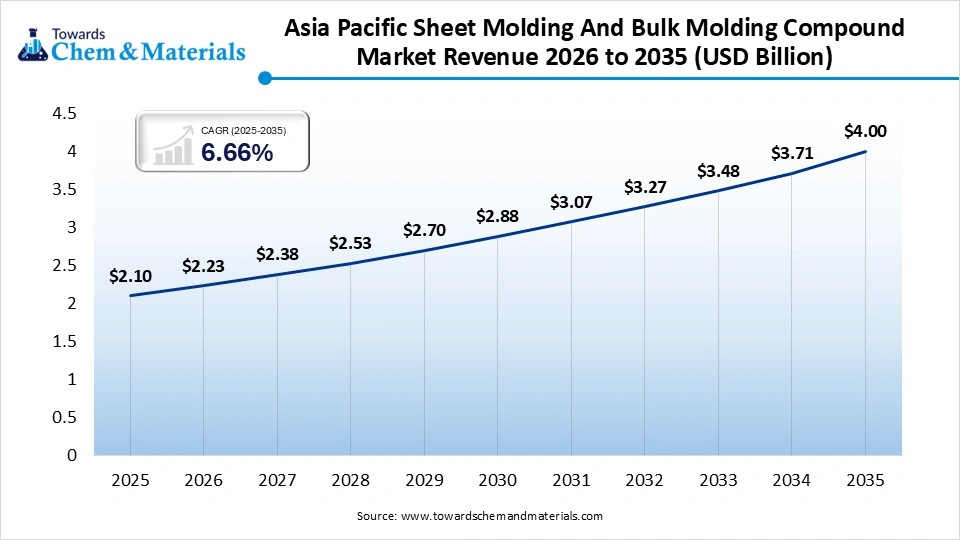
The Asia Pacific sheet molding and bulk molding compound market size was estimated at USD 2.10 billion in 2025 and is projected to reach USD 4.00 billion by 2035, growing at a CAGR of 6.66% from 2026 to 2035 In addition, a surge in the adoption of high-performance molding optimised the adoption of cost-effective and advanced composite production technologies, leading to market growth soon.
China Sheet Molding And Bulk Molding Compound Market Trends
In the Asia Pacific, China dominated the market owing to the increasing demand for fuel-efficient and lightweight vehicles (EVs), ongoing urbanisation, and an extensive low-cost domestic production base for electrical and automotive components. Also, the country remains the major production hub of the Asia Pacific region, offering competitive pricing on essential materials.
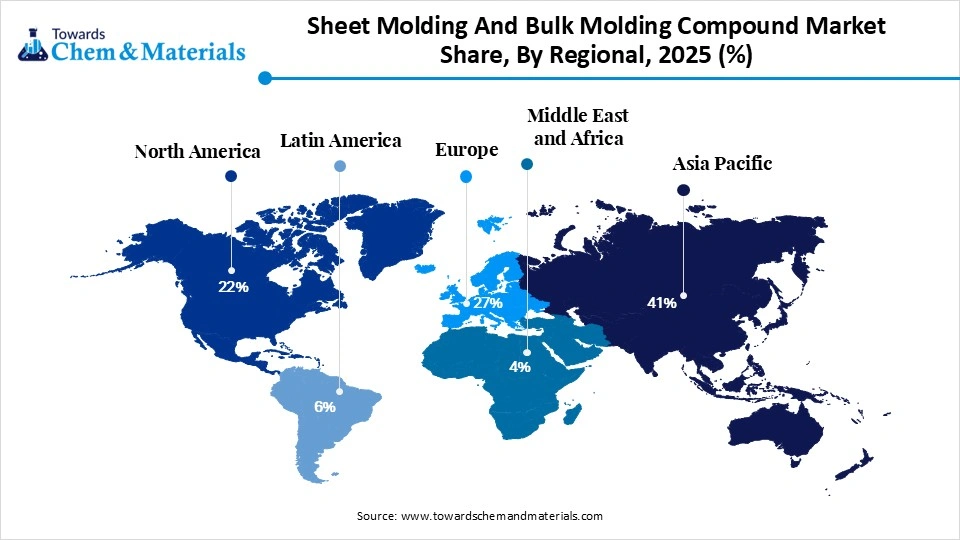
The Middle East & Africa region held a market share of 4% in 2025 and is expected to grow at the fastest CAGR of 7.80% over the forecast period. The growth of the region can be credited to the ongoing infrastructure expansion and increasing demand for advanced composites across various sectors. Furthermore, regional initiatives emphasising local production and economic diversification away from oil dependency fuel the need for certain materials.
Saudi Arabia Sheet Molding And Bulk Molding Compound Market Trends
The growth of the market in the country is due to the increasing demand for lightweight vehicles to enhance fuel efficiency, coupled with the growing demand for better electrical insulation and flame-retardant materials. Moreover, the ongoing deployment of large-scale wind and solar projects creates a high demand for weather-resistant electrical housings.
Recent Development
- In July 2025, SABIC introduced the LNP™ THERMOTUF WF0087N compound, the industry's first nano molding technology (NMT) material based on polybutylene terephthalate (PBT). This innovative compound integrates superior flame retardancy with high mechanical performance.
Sheet Molding And Bulk Molding Compound Market Companies
- BASF SE: BASF SE is a key player in the high-performance composites and plastics market, supplying critical raw materials and compounding solutions, specifically polyamide (PA) grades like Ultramid® and thermoplastics for Sheet Molding Compounds (SMC) and Bulk Molding Compounds (BMC).
- DuPont de Nemours, Inc.: DuPont de Nemours, Inc. is a major player in the high-performance materials sector, providing advanced materials, such as polymers and reinforcing fibers, that enhance the properties of sheet molding (SMC) and bulk molding compounds (BMC).
Companies in the Sheet Molding And Bulk Molding Compound Market
- MENZOLIT
- Polynt (Polynt-Reichhold)
- Continental Structural Plastics Inc. (TEIJIN)
- ZOLTEK (Toray Group)
- Mitsui Chemicals
- TORAY INTERNATIONAL
- Core Molding Technologies
- Devi Polymers Private Limited
Sheet Molding And Bulk Molding Compound Market Segments Covered in the Report
By Product Type
- Sheet Molding Compound (SMC)
- Low Density SMC
- High Strength SMC
- Carbon Fiber SMC
- Class A SMC
- Bulk Molding Compound (BMC)
- Standard BMC
- Flame Retardant BMC
- Glass Reinforced BMC
- Electrical Grade BMC
By Resin Type
- Polyester Resin
- Unsaturated Polyester
- Vinyl Ester Modified Polyester
- Epoxy Resin
- Vinyl Ester Resin
- Phenolic Resin
- Polyurethane Resin
- Others
- Bio-based Resin
- Hybrid Resin Systems
By Fiber Type
- Glass Fiber
- Chopped Strand Glass Fiber
- Continuous Glass Fiber
- Carbon Fiber
- Natural Fiber
- Hemp Fiber
- Flax Fiber
- Hybrid Fiber
By Manufacturing Process
- Compression Molding
- Injection Molding
- Transfer Molding
- Resin Transfer Molding
- Automated Composite Processing
By End-Use Industry
- Automotive
- Passenger Vehicles
- Commercial Vehicles
- Electric Vehicles
- Electrical & Electronics
- Building & Construction
- Aerospace & Defense
- Consumer Appliances
- Energy & Power
- Industrial Equipment
By Distribution Channel
- Direct Sales
- Distributors
- OEM Supply Agreements
- Online Industrial Platforms
By Regions
- North America
- U.S.
- Canada
- Mexico
- Europe
- Germany
- UK
- France
- Italy
- Spain
- Asia Pacific
- China
- India
- Japan
- South Korea
- Latin America
- Brazil
- Argentina
- Middle East & Africa
- Saudi Arabia
- South Africa
FAQ's
Question 1 : Which prime factors are stimulating the growth of the sheet molding and bulk molding compound market?
Answer : Rising population, urbanisation, and industrialisation across the globe are the major factors driving market growth.
Question 2 : Which region dominated the sheet molding and bulk molding compound market?
Answer : Asia Pacific dominated the sheet molding and bulk molding compound market.
Meet the Team

Saurabh Bidwai
Principal Consultant
Saurabh Bidwai, a B.Tech Chemical Engineering graduate with 4+ years of experience, specializes in specialty chemicals, commodity chemicals, and engineered materials, offering valuable insights into market trends and emerging opportunities.

Aditi Shivarkar
Reviewed By
Aditi Shivarkar, with 14+ years in Chemical and Materials market research, specializes in Chemical and Materials. She ensures accurate, actionable insights, driving Towards Chemicals And Materials Analytics and Consulting excellence in industry trends and sustainability.