
Sustainable Feedstock Market Manufacturers & Suppliers Company Analysis 2026-2035
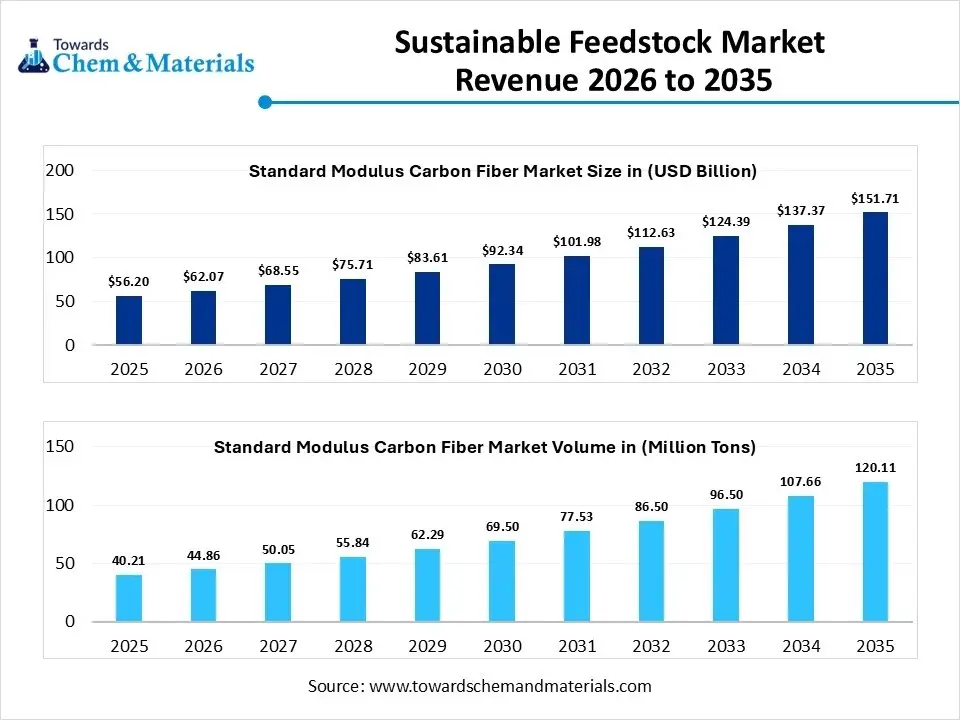
The global sustainable feedstock market size is expected to grow from USD 56.20 billion in 2026 to USD 151.71 billion in 2035, growing at a CAGR of 10.44% from 2026 to 2035. The top Key players in the market are Neste Oyj, TotalEnergies, Shell Aviation, BP Bioenergy, Darling Ingredients Inc., Eni Sustainable Mobility, World Energy, LanzaTech / LanzaJet, NatureWorks LLC, Braskem, Gevo, Inc., Fulcrum BioEnergy, Velocys plc, Enerkem, Borealis AG - Global Forecast 2026 To 2035
Content
What is the Current Sustainable Feedstock Market Size and Volume?
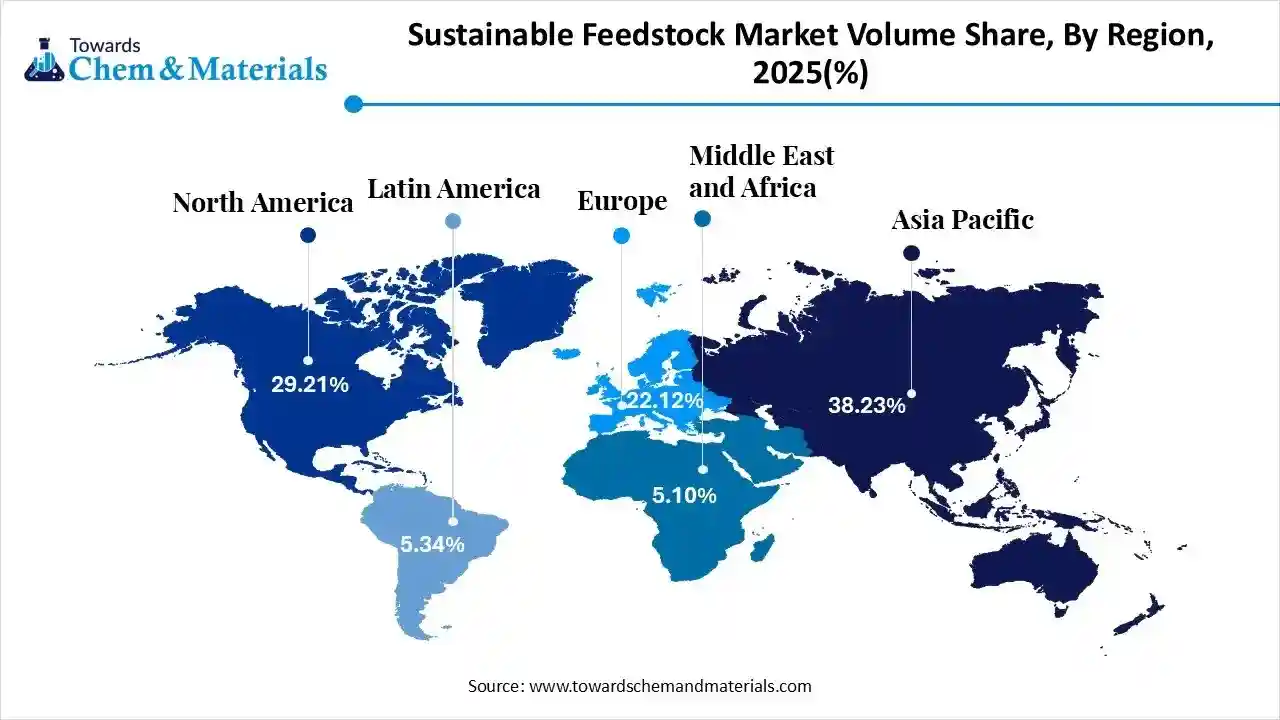
The global sustainable feedstock market size was estimated at USD 56.20 billion in 2025 and is expected to increase from USD 62.07 billion in 2026 to USD 151.71 billion by 2035, growing at a CAGR of 10.44% from 2026 to 2035. In terms of volume, the market is projected to grow from 40.21 million tons in 2025 to 120.11 million tons by 2035. growing at a CAGR of 11.56%% from 2026 to 2035. Asia Pacific dominated the sustainable feedstock market with the largest volume share of 38.23% in 2025. The growing demand for renewable diesel and sustainable aviation fuel (SAF) is the key factor driving market growth. Also, growing demand for biofuels, coupled with the ongoing implementation of decarbonization goals, can fuel market growth further.
Market Highlights
- The Asia Pacific dominated the global sustainable feedstock market with the largest volume share of 38.23% in 2025.
- The sustainable feedstock market in North America is expected to grow at a substantial CAGR of 11.11% from 2026 to 2035.
- The Europe sustainable feedstock market segment accounted for the major volume share of 22.12% in 2025.
- By feedstock type, the 1st generation crop segment dominated the market and accounted for the largest volume share of 51.86% in 2025.
- By feedstock type, the 4th generation segment is expected to grow at the fastest CAGR of 19.34% from 2026 to 2035 in terms of volume.
- By source, the agricultural residues segment led the market with the largest revenue volume share of 30% in 2025.
- By application, the biofuels & renewable fuels segment dominated the market and accounted for the largest volume share of 65% in 2025.
What is Sustainable Feedstock?
Sustainable feedstock refers to renewable, carbon-neutral raw materials such as biomass, agricultural residues, captured, and organic waste- used as inputs for energy, chemicals, and manufacturing. These resources are managed to ensure long-term availability while minimizing environmental degradation, land-use conflict, and greenhouse gas emissions compared to fossil-based counterparts. The sustainable feedstock market refers to the global market for renewable, responsibly sourced raw materials used to produce energy, fuels, chemicals, materials, food, and industrial products while minimizing environmental and social impacts.
These feedstocks are derived from sources such as agricultural residues, forestry biomass, organic waste, algae, recycled materials, and sustainably grown crops, and are managed to reduce greenhouse gas emissions, conserve natural resources, and support long-term ecological and economic sustainability.
Sustainable Feedstock Market Trends
- The rapid innovations in conversion technologies are the latest trend in the market. These technologies are enhancing efficiency and enabling the use of an extensive range of non-food-based feedstocks, like lignocellulosic biomass and algae.
- The growing focus on waste management is another major factor driving positive market growth. The rise in emphasis on using waste streams, such as municipal solid waste (MSW), agricultural residues, and used cooking oil, helps to mitigate waste management challenges.
- The growth of manufacturing capacities is another crucial trend in the market, fuelled by increasing global demand for petrochemical products. Major companies are heavily investing in new facilities and upgrading current ones to enhance efficiency and improve output.
Report Scope
| Report Attribute | Details |
| Market Size and Volume in 2026 | USD 29.10 Billion / 44.86 MillionTons |
| Revenue Forecast in 2035 | USD 44.18 Billion / 120.11 Million Tons |
| Growth Rate | CAGR |
| Forecast Period | 2026 - 2035 |
| Base Year | 2025 |
| Units Considered | Value (Billion / Million), Volume (Million Tons) |
| Dominant Region | Asia Pacific |
| Segment Covered | By Feedstock Type, By Source, By Application, By Region |
| Key companies profiled | Neste Oyj, TotalEnergies, Shell Aviation, BP Bioenergy, Darling Ingredients Inc., Eni Sustainable Mobility, World Energy, LanzaTech / LanzaJet, NatureWorks LLC, Braskem, Gevo, Inc., Fulcrum BioEnergy, Velocys plc, Enerkem, Borealis AG |
How Cutting-Edge Technologies Are Revolutionizing the Sustainable Feedstock Market?
Advanced technologies are revolutionizing the market by facilitating the conversion of extensive waste streams into valuable resources, strengthening agricultural manufacturing through data and automation. Furthermore, rapid advancements in materials are enhancing the durability and efficiency. Nanotechnology is also utilized in nano catalysts for waste conversion.
Trade Analysis of Sustainable Feedstock Market: Import & Export Statistics
Exports
- In 2024, China exported $1.17B of Biodiesel and mixtures thereof, being the 409th most exported product in China.
- In 2024, the main destinations of China's Biodiesel and mixtures thereof exports were: the Netherlands ($731M), Singapore ($169M), Malaysia ($93.4M), Belgium ($77.2M), and Hong Kong ($25.4M).
Imports
- In 2024, China imported $12M of Biodiesel and mixtures thereof, being the 964th most imported product in China.
- In 2024, the main origins of China's Biodiesel and mixtures thereof imports were: Malaysia ($10M), Singapore ($994k), Indonesia ($685k), Thailand ($76.2k), and Australia ($73.1k).(Source: oec.world)https://oec.world/en/profile/bilateral-product/biodiesel-and-mixtures-thereof/reporter/chn
Sustainable Feedstock Market Value Chain Analysis
- Feedstock Procurement :It is the sourcing of raw materials such as used oils, algae, and agricultural waste, emphasizing environmental/social benefits.
- Major Players: TotalEnergies, STX Group.
- Chemical Synthesis and Processing :It is the crucial stage where renewable raw materials are chemically transformed into usable intermediate and final products such as fuels and green chemicals.
- Major Players: SABIC, ExxonMobil Chemical.
- Packaging and Labelling:It is the essential process that ensures the physical containment, protection, and product information using materials.
- Major Players: Sonoco Products Company, Tetra Pak.
- Regulatory Compliance and Safety Monitoring:It involves adhering to stringent national, international, and voluntary standards to ensure products are safe and environmentally sound.
- Major Players: Drax Group plc, BASF SE.
Sustainable Feedstock Market 's Regulatory Landscape: Global Regulations
| Country/Region | Key Regulations |
| European Union (EU) | The EU has a comprehensive framework, primarily driven by the Renewable Energy Directive (RED II) and upcoming regulations like the EU Deforestation Regulation (EUDR). |
| United States | Inflation Reduction Act (IRA): The IRA provides significant financial incentives and tax credits for sustainable aviation fuel (SAF) and biodiesel production, encouraging the use of sustainable feedstocks. |
| United Kingdom (UK) | The SAF mandate sets a target of 2% SAF in the aviation fuel mix by 2025, increasing to 10% by 2030. Suppliers must use certified feedstocks that meet specific GHG reduction thresholds |
Segment Insights
Feedstock Type Insight
How Much Share Did the 1st Generation Crop Segment Held in 2025?
The 1st generation crop segment volume was valued at 20.85 million tons in 2025 and is projected to reach 62.02 million tons by 2035, expanding at a CAGR of 12.88% during the forecast period from 2025 to 2035. The 1st generation crop segment dominated the market with 52% share in 2025. The dominance of the segment can be attributed to the growing demand for lower carbon emissions and renewable energy sources in the transportation industry. In addition, these biofuels are derived from sugarcane, corn, and vegetable oils, and benefit from well-established and mature manufacturing processes.

The 4th generation segment volume was valued at 1.25 million tons in 2025 and is expected to surpass around 6.16 million tons by 2035, and it is anticipated to expand to 19.34% of CAGR during 2026 to 2035. The growth of the segment can be credited to the ongoing push toward carbon-negative solutions, along with the strict government regulations to minimize overall emissions. The 4G algae can be cultivated on land unsuitable for agriculture, to prevent conflict between "food vs. fuel".
Sustainable Feedstock Market Volume and Share, By Feedstock Type, 2025-2035
| By Feedstock Type | Market Volume Share (%), 2025 | Market Volume (Mn. Tons)2025 | Market Volume (Mn. Tons)2035 | CAGR(%) 2026-2035 | Market Volume Share (%), 2035 |
| 1st Generation [Crop-Based] | 51.86% | 20.85 | 62.02 | 12.88% | 51.64% |
| 2nd Generation [Waste & Residues] | 38.01% | 15.28 | 42.19 | 11.94% | 35.13% |
| 3rd Generation [Algae & Aquatic] | 7.01% | 2.82 | 9.73 | 14.76% | 8.10% |
| 4th Generation [Carbon Capture/E-Fuels] | 3.12% | 1.25 | 6.16 | 19.34% | 5.13% |
Source Insights
Which Source Type Segment Dominated Sustainable Feedstock Market in 2025?
The agricultural residues segment held a 30% market share in 2025. The dominance of the segment can be linked to the rapid technological advancements in waste conversion and massive material availability. Moreover, these residues are byproducts of existing crop production, which means they do not necessitate additional land or compete with food crops.
The municipal & industrial waste segment is expected to grow at the fastest CAGR over the forecast period. The growth of the segment can be driven by strict environmental regulations and a surge in waste volumes because of rapid urbanization. Also, governments across the globe are increasingly enforcing stringent regulations to reduce greenhouse gas (GHG) emissions.
Application Insight
Which Application Type Segment Dominated Sustainable Feedstock Market in 2025?
The biofuels & renewable fuels segment held a 65%market share in 2025. The dominance of the segment is owed to ongoing investment in corporate sustainability targets and increasing demand for energy security. Furthermore, biofuels improve energy independence by minimizing dependence on imported fossil fuels to ensure stable energy supplies.
The sustainable aviation fuel (SAF) segment is expected to grow at the fastest CAGR during the projected period. The growth of the segment is due to the extensive availability of feedstocks and the increase in air traffic. Moreover, advancements in Alcohol-to-Jet (ATJ) pathways are enhancing overall fuel yields and minimizing manufacturing costs significantly.
Regional Insights:
The Asia Pacific sustainable feedstock market size was valued at USD 21.98 billion in 2025 and is expected to be worth around USD 59.33 billion by 2035, exhibiting at a compound annual growth rate (CAGR) of 10.46% over the forecast period from 2026 to 2035.
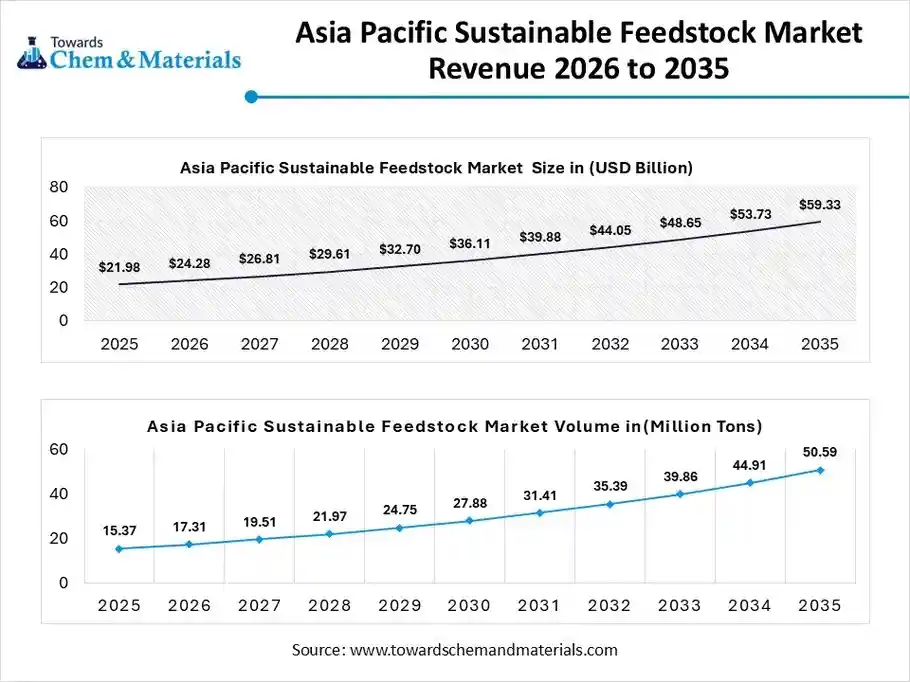
The Asia Pacific sustainable feedstock market volume was estimated at 15.37 million tons in 2025 and is projected to reach 50.59 million tons by 2035, growing at a CAGR of 14.15% from 2026 to 2035. The Asia Pacific is expected to grow at the fastest CAGR over the forecast period. The growth of the region can be attributed to the robust government policies and increasing need for energy security. In addition, rapid innovations in processing agricultural residues, algae, and waste make second-generation biofuels more convenient, alleviating food-vs-fuel concerns. The region's strong agriculture sector offers diverse feedstocks like sugarcane and palm oil.
How Did North America Thrived in the Sustainable Feedstock Market in 2025?
The North America sustainable feedstock market volume was estimated at 11.75 million tons in 2025 and is projected to reach 30.32 million tons by 2035, growing at a CAGR of 11.11% from 2026 to 2035.North America is expected to dominate the market with the largest share in 2025. The dominance of the region can be credited to the rapid investment in R&D for waste-to-energy solutions, along with the technological innovations in conversion processes. The ongoing population growth and urbanisation boost energy demand, while strict pollution regulations push for low-carbon, renewable sources.
U.S. Sustainable Feedstock Market Trends
In North America, the U.S. led the market due to a surge in investment in cutting-edge biofuels and increasing environmental awareness among a large population. The country is a major region for the expansion of sustainable feedstocks, especially for SAF, because of expanding manufacturing capacity and strong policy support with a focus on investments.
China Sustainable Feedstock Market Trends
In the Asia Pacific, China dominated the market owing to the ongoing push towards decarbonization and rapid technological innovations in conversion. Also, escalating manufacturing infrastructure, especially in chemicals and petrochemicals, fuels demand for reliable and diverse feedstocks with an increasing emphasis on sustainable alternatives.
Sustainable Feedstock Market Volume and Share, By Region, 2025-2035
| By Region | Market Volume Share (%), 2025 | Market Volume (Mn. Tons)2025 | Market Volume (Mn. Tons)2035 | CAGR(%) 2026-2035 | Market Volume Share (%), 2035 |
| North America | 29.21% | 11.75 | 30.32 | 11.11% | 25.24% |
| Europe | 22.12% | 8.89 | 28.98 | 14.03% | 24.13% |
| Asia Pacific | 38.23% | 15.37 | 50.59 | 14.15% | 42.12% |
| South America | 5.34% | 2.15 | 5.40 | 10.80% | 4.50% |
| Middle East & Africa | 5.10% | 2.05 | 4.82 | 9.95% | 4.01% |
Europe Sustainable Feedstock Market Trends
The Europe sustainable feedstock market volume was estimated at 8.89 million tons in 2025 and is projected to reach 28.98 million tons by 2035, growing at a CAGR of 14.03% from 2026 to 2035. Europe is expected to grow at a notable CAGR over the forecast period. The growth of the region can be driven by growing consumer demand for green products, coupled with the rising emphasis on feedstock diversification. Furthermore, brand owners are increasingly investing in sustainable feedstocks to fulfil their own sustainability goals, driving regional growth soon.
Germany Sustainable Feedstock Market Trends
In Europe, Germany dominated the market owing to the growing consumer & corporate demand for decarbonization, particularly in transport and chemicals, along with the advancements in advanced biofuels. Also, the country is highly dependent on domestic biofuels and imported fossil fuels, improving overall supply chain resilience and contributing to market growth.
Latin America Sustainable Feedstock Market Trends
The Latin America sustainable feedstock market volume was estimated at 2.15 million tons in 2025 and is projected to reach 5.40 million tons by 2035, growing at a CAGR of 10.80% from 2026 to 2035. The growth of the market in Latin America can be driven by increasing emphasis on using agro-industrial byproducts, such as animal fats, cooking oil (UCO), and forestry residues for biofuels. Moreover, robust government policies and heavy private investments are propelling market expansion, with emerging projects such as Paraguay's Omega Green SAF plant.
Brazil Sustainable Feedstock Market Trends
In Latin America, Brazil led the market due to the increasing emphasis on feedstock diversification and innovative tech for efficiency, along with the emerging opportunities in biojet fuel. In addition, Brazil is using its low-cost renewable grid to become a major leader in GH2, accelerating market growth further in the country.
Middle East and Africa Sustainable Feedstock Market Trends
The Middle East and Africa sustainable feedstock market volume was estimated at 2.05 million tons in 2025 and is projected to reach 4.82 million tons by 2035, growing at a CAGR of 9.95% from 2026 to 2035. The growth of the market in the Middle East & Africa can be boosted by its strong agricultural potential, ongoing decarbonization efforts, and energy security initiatives. Additionally, major companies in the region are combining carbon capture technology to create green and blue feedstocks for the petrochemical industry, driven by lower carbon emission policies.
Saudi Arabia Sustainable Feedstock Market Trends
Saudi Arabia held a significant market share in 2025. The growth of the country can be propelled by the ongoing development of bio-based chemicals and robust consumer preference for green chemicals. Also, growth in bio-plasticizers, oleochemicals, and furfural for different industrial applications can impact positive market growth soon.
Recent Developments
- In January 2026, Corteva and bp launched biofuel feedstock joint venture Etlas to manufacture and deliver biofuel feedstocks to global markets. It will use both Corteva's century-long expertise in seed technology to create a crop suited to produce SAF and RD.(Source: www.bp.com)
Sustainable Feedstock Market Companies
- Neste Oyj: Neste Oyj is the world's leading producer of sustainable aviation fuel (SAF) and renewable diesel, primarily by refining a wide range of global waste and residue raw materials.
- TotalEnergies: TotalEnergies is a major player in the sustainable feedstock market, shifting its focus toward circular resources like used cooking oil (UCO) and animal fats to decarbonize liquid fuels.
- Shell Aviation
- BP Bioenergy
- Darling Ingredients Inc.
- Eni Sustainable Mobility
- World Energy
- LanzaTech / LanzaJet
- NatureWorks LLC
- Braskem
- Gevo, Inc.
- Fulcrum BioEnergy
- Velocys plc
- Enerkem
- Borealis AG
Segments Covered in the Report
By Feedstock Type
- 1st Generation (Crop-based)
- 2nd Generation (Waste & Residues)
- 3rd Generation (Algae & Aquatic)
- 4th Generation (Carbon Capture/E-fuels)
By Source
- Agricultural Residues
- Waste Oils & Fats (UCO/Tallow)
- Municipal & Industrial Waste
- Dedicated Energy Crops
- Forestry & Wood Waste
By Application
- Biofuels & Renewable Fuels
- Chemicals & Petrochemicals
- Bioplastics & Packaging
- Power & Heat Generation
- Sustainable Aviation Fuel (SAF)
- Others (Pharmaceuticals/Construction)
By Region
- North America
- U.S.
- Canada
- Mexico
- Europe
- Germany
- UK
- France
- Italy
- Spain
- Asia Pacific
- China
- India
- Japan
- South Korea
- Latin America
- Brazil
- Argentina
- Middle East & Africa
- Saudi Arabia
- South Africa
FAQ's
Question 1 : What is the Sustainable Feedstock market size volume?
Answer : The global sustainable feedstock market size is projected to grow from USD 62.07 billion in 2026 to USD 151.71 billion by 2035. This represents a steady compound annual growth rate CAGR of 10.44%. In terms of volume the market is expected to expand from 44.86 million tons in 2026 to 120.11 million tons by 2035 as industries pivot from fossil based raw materials to renewable biomass and waste streams.
Question 2 : Who are the leading companies operating in the Sustainable Feedstock market?
Answer : The top Key players in the market are Neste Oyj, TotalEnergies, Shell Aviation, BP Bioenergy, Darling Ingredients Inc., Eni Sustainable Mobility, World Energy, LanzaTech / LanzaJet, NatureWorks LLC, Braskem, Gevo, Inc., Fulcrum BioEnergy, Velocys plc, Enerkem, Borealis AG
Question 3 : Which feedstock type offers the highest investment potential through 2035?
Answer : While 1st Generation Crop Based feedstocks held the largest volume share of 51.86% in 2025 the highest investment potential lies in 4th Generation Carbon Capture and E-Fuels. This segment is projected to grow at a rapid CAGR of 19.34%. Investors are increasingly focusing on these carbon negative solutions to bypass the food versus fuel conflict associated with traditional agricultural crops.
Question 4 : What are the primary growth drivers for Sustainable Aviation Fuel SAF feedstocks?
Answer : The rapid expansion of the Sustainable Aviation Fuel SAF segment is driven by global decarbonization mandates like the EU SAF mandate and the US Inflation Reduction Act. Technological shifts in Alcohol to Jet ATJ pathways and the increasing availability of waste oils and fats are making SAF the fastest growing application within the sustainable feedstock landscape.
Question 5 : How is technology disrupting the sustainable feedstock value chain?
Answer : Cutting edge technologies such as nanotechnology in catalysts and AI driven supply chain automation are revolutionizing waste conversion. Advanced chemical synthesis allows for the processing of non food based feedstocks like lignocellulosic biomass and algae. These innovations are significantly lowering production costs and enhancing the durability of bio based end products.
Question 6 : Which regions are dominating the global sustainable feedstock trade?
Answer : Asia Pacific led the market with a 38.23% volume share in 2025 supported by a robust agricultural base and massive investments in China and India. North America follows closely with a projected CAGR of 11.11% fueled by federal tax credits for renewable diesel. Europe remains a critical regulatory leader driven by the Renewable Energy Directive RED II.
Meet the Team

Saurabh Bidwai
Principal Consultant
Saurabh Bidwai, a B.Tech Chemical Engineering graduate with 4+ years of experience, specializes in specialty chemicals, commodity chemicals, and engineered materials, offering valuable insights into market trends and emerging opportunities.

Aditi Shivarkar
Reviewed By
Aditi Shivarkar, with 14+ years in Chemical and Materials market research, specializes in Chemical and Materials. She ensures accurate, actionable insights, driving Towards Chemicals And Materials Analytics and Consulting excellence in industry trends and sustainability.