
Sustainable Textiles Market Size, Share & Trends Analysis Report by 2026-2035
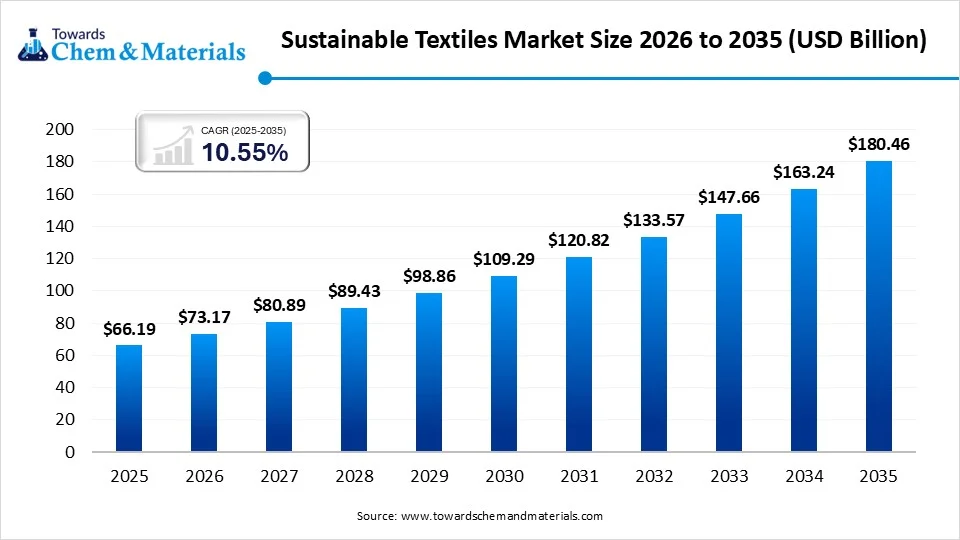
The global sustainable textiles market size is expected to grow from USD 73.17 billion in 2026 to USD 180.46 billion in 2035, growing at a CAGR of 10.55% from 2026 to 2035. The top key players in the market are Patagonia, Inc., Lenzing AG, Adidas AG, H&M Group, Inditex, Grasim Industries (Birla Cellulose), Teijin Limited, Under Armour, Inc., Eileen Fisher, Unifi, Inc., Renewcell, Toray Industries, Inc., Pact, LLC, G-Star Raw, Allbirds-Global Forecast 2026 To 2035
Content
What is the Current Sustainable Textiles Market Size and Share?
The global sustainable textiles market size was estimated at USD 66.19 billion in 2025 and is expected to increase from USD 73.17 billion in 2026 to USD 180.46 billion by 2035, growing at a CAGR of 10.55% from 2026 to 2035. Asia Pacific dominated the sustainable textiles market with the largest revenue share of 36% in 2025.The market is driven by environmentally conscious consumers, regulatory pressure and the adoption of smart textiles, boosting innovation & collaboration. The global sustainable textiles market is entering a pivotal era in 2026, moving from take-make-waste models to the circular economy and technological intelligence. This shift involves using regenerative materials and closed-loop systems to reduce resource depletion and restore ecosystems. Manufacturers are adopting bio-engineering and recycling techniques, such as chemical regeneration of synthetic fibers and using agricultural byproducts, to meet consumer demands for transparency and resilience. Additionally, the surge in smart and bio-fabricated textiles that are high-performing and biodegradable ensures the garments' safety and long-term reliability. The growth is supported by global regulations and corporate governance, and the market is developing into a resilient environment, where sustainability drives innovation and industry brilliance.
Market Highlights
- The Europe dominated sustainable textiles market with the largest revenue share of 36% in 2025. due to its strong regulatory framework and culture of slow fashion.
- By region, Asia Pacific is expected to grow at the fastest CAGR from 2026 to 2035 due to innovation for decarbonization and close-loop network.
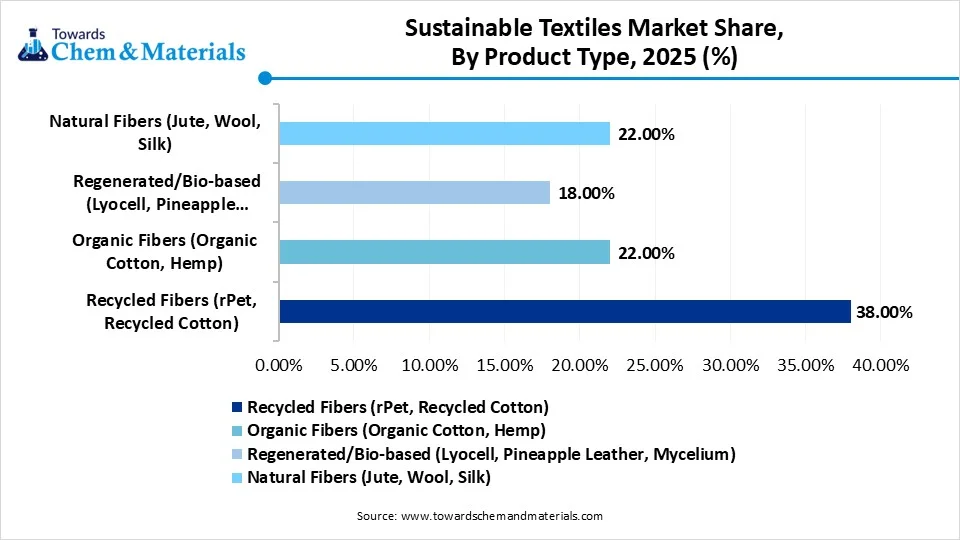
- By product type, the recycled fibers segment held the largest, approximately 38% share in the market in 2025 due to the industrial shift to circularity and advanced chemical recycling.
- By product type, the organic fibers segment is expected to grow at the fastest CAGR during the forecast period due to a focus on regenerative agricultural goals and long-term reliability.
- By application, the apparel & fashion segment dominated with approximately 61% share in the market, driven by its demand for eco-friendly products and focus toward the style-to-disposal lifecycle.
- By application, the home textiles segment is expected to grow at the fastest CAGR in the market during the forecast period due to rising focus on low-toxicity and a circular ecosystem.
- By distribution channel, the mass market segment held the largest, approximately 61% share of the market due to its democratization of circularity and technological advancement.
- By distribution channel, the premium/luxury segment is expected to grow at the fastest CAGR due to its adoption of high-performance bio-fabrication and ecological integrity.
- By business model, the traditional retail segment dominated with a held approximately 65% share in the market due to its hybrid circular hub and AI-driven system.
- By business model, the circular/resale platforms segment is anticipated to grow at the fastest CAGR in the market during the forecast period due to its value-per-wear ecosystem and resource longitivity.
Key Technological Shifts and AI in the Sustainable Textiles Market
The market is increasingly driven by digital circularity, with AI and advanced molecular engineering at the core of manufacturing. Predictive manufacturing using AI matches demand with zero-waste robotic 3D weaving. AI-based material informatics helps develop programmable bio-fibers with lower carbon content and biodegradable.
Additionally, textile waste is reduced through hyperspectral sorting and computerized chemical depolymerization, with deep learning systems recovering pure polymers from mixed fibers clothes. The blockchain-based Digital Product Passports ensure traceability, creating a transparent and efficient supply chain network where closed-loop data-driven growth aligns with environmental goals.
Trade Analysis of the Sustainable Textiles Market: Import and Export Statistics
- India exported 531 shipments of sustainable textiles.
- China exported 170 shipments of sustainable textiles.
- Taiwan exported 40 shipments of sustainable textiles.
- From July 2024 to June 2025, the world exported 209 shipments of sustainable textiles.
Sustainable Textiles Market Trends
- Shift Towards Circular Economy: The rising consumer awareness is driving the global shift towards the circular economy, which is reshaping sustainable textiles that are focused on sustainable, recyclable, or compostable at the end of their life cycle
- Innovation-Driven Textiles: The focus on sustainable material including biodegradable textiles and organic materials, supported by a closed-loop production technique, driving this trend aligns with smart textiles.
Report Scope
| Report Attribute | Details |
| Market Size in 2026 | USD 180.46 Billion |
| Revenue Forecast in 2035 | USD 73.17 Billion |
| Growth Rate | CAGR 10.55% |
| Forecast Period | 2026 - 2035 |
| Base Year | 2025 |
| Dominant Region | Asia Pacific |
| Segment Covered | By Product Type, By Application, By Distribution Channel, By Business Model, By Region |
| Key companies profiled | Patagonia, Inc., Lenzing AG, Adidas AG, H&M Group, Inditex, Grasim Industries (Birla Cellulose), Teijin Limited, Under Armour, Inc., Eileen Fisher, Unifi, Inc., Renewcell, Toray Industries, Inc., Pact, LLC, G-Star Raw, Allbirds |
Sustainable Textiles Market: Value Chain Analysis
- Regenerative Feedstock Procurement: The initial stage involves raw material sourcing to ecosystem restoration by using AI to optimize crop yield for natural fibres and accelerates discovery of new bio-material synthesis.
- Key Players: Spiber Inc., Lenzing AG, MycoWorks and Bolt Threads
- Smart Manufacturing: The stage of utilization of AI-driven precision to convert raw materials into yarn and fabrics by using dyeing, AI-driven spinning, and 3D weaving to ensure precise resource consumption. Aimed at eliminating hazardous chemicals and producing zero-waste garments.
- Key Players: Unspun, DyeCoo, Arvind Limited and Colorifix
- Circular Distribution and Smart Recovery: The final stage utilizes digital product passports to track garment composition and AI-driven sorting for recycling. It also involves blockchain-enabled traceability and recommerce platforms for distribution.
- Key Players: Aquafil, Renewcell, Trusupply and Infinited Fiber Company.
Regulatory Framework: Sustainable Textiles Market
| Region | Key Regulation | Regulatory Focus |
| Global | UN Sustainable Development Goals, ISSB Climate Disclosure (IFRS S2) | The standard focuses on identifying environmental risks in the textile and footwear supply chain, regulation reinforcing textile firms to lower their carbon impact in raw materials. |
| European Union | Ecodesign for Sustainable Products Regulation (ESPR), Digital Product Passport (DPP), Green Claims Code (UK), UPV Textiles Decree (Netherlands) | Regulation focuses on product environmental footprint life-cycle assessment, mandates blockchain-enabled traceability |
| United States | NY Fashion Act, The fashion Sustainability and social accountability act | Target for climate and focus to lower environmental impact |
| China | Green Textile Evaluation Standard | Focus on zero-liquid discharge in textile dyeing and green production standards. |
| France | Anti-Waste for a Circular Economy (AGEC) Law and Triman Logo | Standards for environmental labelling and map their Tier 1-4 supply chain to ensure sustainable fiber sourcing |
Segmental Insights
Product Type Insights
Why the Recycled Fibers Segment Dominates the Sustainable Textiles Market?
The recycled fibers segment dominated the market with approximately 38% share in 2025. The primary feedstock for the global apparel industry is driven by technological advances in automated molecular recycling and AI sorting that produce high-quality yarns from complex waste. The stringent regulations and taxes on virgin resources make reclaimed fibers the most economical alternative for mass production, transforming waste streams into high-performance post-consumer garments as closed-loop assets that reshape textile economics to focus on resource stability for climate-resilient economy.
The organic fibers segment is the fastest-growing in the market during the forecast period, shifting from basic sustainability to regenerative agricultural practices that use AI and blockchain to verify pesticide-free purity, eco-friendly fibers like cotton and hemp. Additionally, the rising health-conscious demand for biodegradable and hypoallergenic materials positions organic fibers as the standard for transparency, safety, and ecosystem health.
Sustainable Textiles Market Share, By Product Type, 2025 (%)
| By Product Type | Revenue Share, 2025 (%) |
| Recycled Fibers (rPet, Recycled Cotton) | 38.00% |
| Organic Fibers (Organic Cotton, Hemp) | 22.00% |
| Regenerated/Bio-based (Lyocell, Pineapple Leather, Mycelium) | 18.00% |
| Natural Fibers (Jute, Wool, Silk) | 22.00% |
Application Insights
How did the Apparel & Fashion Segment hold the Largest Share in the Sustainable Textiles Market?
The apparel & fashion segment held the largest revenue share of approximately 61% in the market in 2025, fueled by growing consumer demand for ethical production methods and environmentally friendly apparel. Fashion brands are increasingly using bio-based, organic, and recycled textiles to lessen their environmental impact and achieve sustainability goals. Furthermore, the global transition to sustainable fashion is being accelerated by regulatory pressure and rising consumer awareness among younger consumers.
The home textiles segment is experiencing the fastest growth in the market during the forecast period. The expansion is driven by the transition to redefining sustainable living by creating low-impact, circular environments with durable, recyclable polymer and regenerative materials by integration of AI-optimised finishes that replace toxic chemicals. Its applications like carpeting, upholstery, bedding and drapery are now implanted with digital product passports, enabling resource recovery and end-of-life regeneration that serve as a closed-loop domestic ecosystem, positioning home textiles as long-lasting, toxin-free household resources.
Sustainable Textiles Market Share,By Application, 2025 (%)
| By Application | Revenue Share, 2025 (%) |
| Apparel & Fashion | 61.00% |
| Home Textiles | 18.00% |
| Technical Textiles (Medical, Automotive) | 12.00% |
| Industrial/Geotextiles | 9.00% |
Distribution Channel Insights
Which Distribution Channel Dominated the Sustainable Textiles Market?
The mass market segment dominated the market with approximately 61% share in 2025, due to transitioning green innovations into an accessible and affordable production to global industrial standards through AI logistics and automated micro-factories. This scale supports resource recovery and blockchain verification, transforming the mass market into a significant powerhouse for environmental restoration and high-velocity circular economy.
The premium/luxury segment is anticipated to grow fastest in the market during the forecast period. The market is driven by a shift towards a heritage circularity model and implementation of high-performance bio-materials like spider silk and mycelium to create high-end fashion. Blockchain-verified digital twins and a focus on artisanal durability promote sustainability as a mark for maintaining ecological integrity with a regenerative footprint.
Sustainable Textiles Market Share,By Distribution Channel, 2025 (%)
| By Distribution Channel | Revenue Share, 2025 (%) |
| Mass Market | 61.00% |
| Premium/Luxury | 39.00% |
Business Model Insights
How did the Traditional Retail Segment hold the Largest Share in the Sustainable Textiles Market?
The traditional retail segment held the largest revenue share of approximately 65% in the market in 2025. by evolving into a circular hub that combines digital transparency with physical trace. The segment acts as resource reclamation centres for garment take-back and repair, using AI-driven store analytics to eliminate deadstock and maintain verified bio-fabricated and regenerative collections. Additionally, blockchain-enabled QR codes allow consumers to engage with a garment’s lifecycle, turning traditional shops into community newscasters for circularity and boosting mass-market trust.
The circular/resale platforms segment is experiencing the fastest growth in the market during the forecast period. Industries are shifting from volume-based to value-per-wear infrastructure, with AI-powered lifecycle management. The digital Product Passports enable a stable connection with the garment, and blockchain allows instantaneous verification. Additionally, the integrated reverse logistics and robotic repairs help recapture product value, transforming garments into assets that generate profits and an asset-recovery loop.
Sustainable Textiles Market Share, By Business Model, 2025 (%)
| By Business Model | Revenue Share, 2025 (%) |
| Traditional Retail | 65.00% |
| Circular/Resale Platforms | 35.00% |
Regional Insights
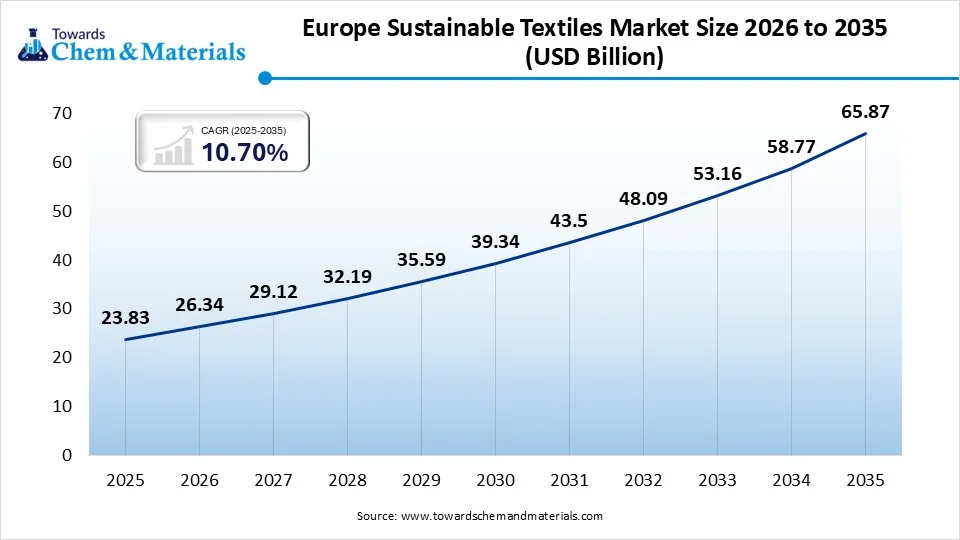
The Europe sustainable textiles market size was valued at USD 23.83 billion in 2025 and is expected to be worth around USD 65.87 billion by 2035, exhibiting at a compound annual growth rate (CAGR) of 10.70% over the forecast period from 2026 to 2035.Europe dominated the market with approximately 36.00% share in 2025. The growth is driven by enforcing the EU Strategy for Sustainable and Circular Textiles, banning waste destruction in unsold apparel and requiring Digital Product Passports for environmental verification. Europe’s infrastructure includes chemical recycling and bio-fabrication hubs, relocating virgin synthetics through closed-loop economies with extended producer responsibility in industrial scale.
Germany Sustainable Textiles Market Growth Trends
Germany is leading the market, driven by its regulatory framework and technological advancement, moving from niche eco-offerings to a standardized circular economy. The expansion favoured by a stringent law that prohibits destroying unsold clothes and requires blockchain transparency, ending greenwashing by the Anti-Greenwashing law. The dominance is sustained by high-tech textile hubs that focus on waterless processing and chemical recycling, while consumers drive demand for regenerative organic and fair-trade fibers. Overall. The governmental regulation, innovation, and environmental commitment positions Germany as a leader in the demanding fashion ecosystem.
Asia Pacific Sustainable Textiles Market Growth Trends
Asia Pacific sustainable textiles market segment accounted for the major revenue share of 25.00% in 2025. Asia Pacific is expected to grow at the fastest CAGR in the market during the forecast period. The region is a global innovation leader in decarbonized manufacturing and the circular economy. The leadership is due to AI-driven scaling of waterless dyeing, CO2 processing, and regenerative bio-fibres from crop waste into high-performance textiles. Blockchain traceability supports the production of high-accuracy recycled polymers and a closed-loop network, ensuring environmental and industrial growth.
China Sustainable Textiles Market Growth Trends
China market is shifting from mass manufacturing to green innovation and circularity, supported by government policies for carbon neutrality. The implementation of waterless dyeing and renewable energy, alongside domestic demand for eco-friendly apparel that prefers organic fibers and recycled synthetics fueling market expansion. AI-powered sorting and chemical recycling hubs help convert textile waste into high-quality fibers, making China a significant player in the global circular economy.
North America Sustainable Textiles Market Growth Trends
North America sustainable textiles market segment accounted for the major revenue share of 28.00% in 2025. North America is an emerging market driven by combination of advanced biotechnology and digital circularity, shifting from eco-labels to regenerative manufacturing with lab-grown bio-materials and crop waste fibers moving away from traditional synthetics. The region's strict regulations promote supply chain transparency and mandatory environmental disclosures. Moreover, AI-optimized resale ecosystem integrating with Silicon Valley technological innovation turns textile waste into a valuable resource, making core driver of sustainability in the industry and consumer goods.
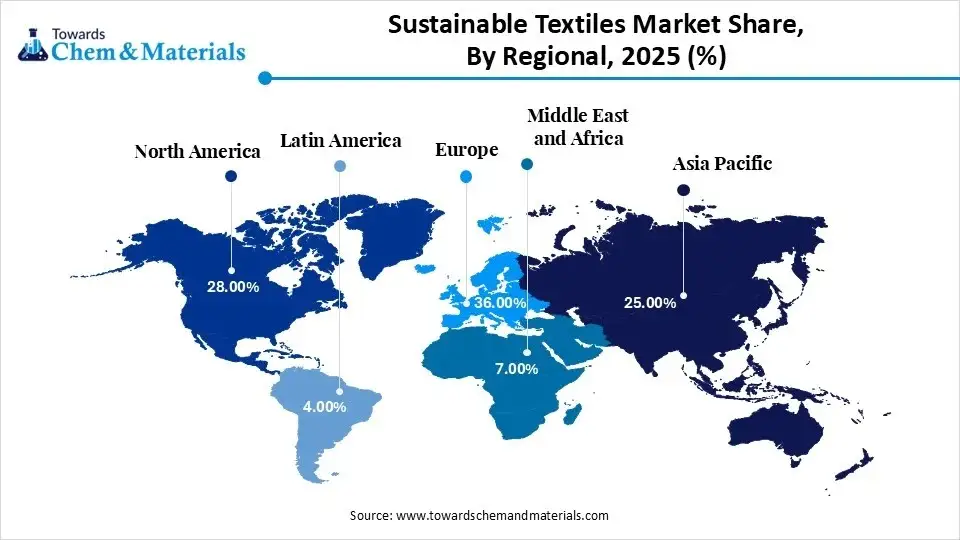
Sustainable Textiles Market Share, By Regional, 2025 (%)
| Regional | Revenue Share, 2025 (%) |
| North America | 28.00% |
| Europe | 36.00% |
| Asia Pacific | 25.00% |
| Latin America | 4.00% |
| Middle East & Africa | 7.00% |
U.S. Sustainable Textiles Market Growth Trends
The U.S. market is characterized by a shift towards domestic manufacturing and biotechnology integration. The rising focus on the development of regenerative hubs transforms agricultural waste and lab proteins into high-performance fibers, supported by stringent laws like EPR and supply chain mandates that turn waste into financial liabilities. Additionally, the U.S. leads in AI-based resale and precision-based chemical recycling, scaling garment repair and sorting, by using digital and automated infrastructure, accelerating apparel growth from resource extraction, and setting new standards for regenerative fashion.
Recent Developments
- In December 2025, Circulose and Birla Cellulose announced a strategic alliance agreement to produce-high quality and sustainable fiber solution. The partnerships focus on scaling recycling to advance circular textiles.(Source: www.circulose.com)
- In August 2025, the breakthrough collaboration between HKUST, Crystal Group and HKRITA established a global textile hub for AI research in textiles. The partnership focuses on transforming the textile and apparel industry through the integration of Artificial intelligence.(Source: hometex.imconlinereg.com)
Top Companies and Their Offerings
- Patagonia, Inc.: The major player that offers material permanence and ecosystem restoration. The company create a standard for traceability
- Lenzing AG: The global leader focuses on closed-loop cellulose production to create carbon-neutral luxury fibers. The key provider for low-carbon wood-based fibres.
- Adidas AG
- H&M Group
- Inditex
- Grasim Industries (Birla Cellulose)
- Teijin Limited
- Under Armour, Inc.
- Eileen Fisher
- Unifi, Inc.
- Renewcell
- Toray Industries, Inc.
- Pact, LLC
- G-Star Raw
- Allbirds
Segment Covered in the Report
By Product Type
- Recycled Fibers (rPet, Recycled Cotton)
- Organic Fibers (Organic Cotton, Hemp)
- Regenerated/Bio-based (Lyocell, Pineapple Leather, Mycelium)
- Natural Fibers (Jute, Wool, Silk)
By Application
- Apparel & Fashion
- Home Textiles
- Technical Textiles (Medical, Automotive)
- Industrial/Geotextiles
By Distribution Channel
- Mass Market
- Premium/Luxury
By Business Model
- Traditional Retail
- Circular/Resale Platforms
By Region
- North America
- U.S.
- Canada
- Mexico
- Europe
- Germany
- UK
- France
- Italy
- Spain
- Asia Pacific
- China
- India
- Japan
- South Korea
- Latin America
- Brazil
- Argentina
- Middle East & Africa
- Saudi Arabia
- South Africa
FAQ's
Question 1 : What are the key growth drivers for the sustainable textiles market?
Answer : The sustainable textiles market is driven by increasing consumer awareness, regulatory pressure, and innovations in smart textiles and circular economy practices.
Question 2 : How will technology disrupt the sustainable textiles market?
Answer : Technology disruptions like AI-powered recycling, bio-fabrication, and blockchain-based traceability are transforming production, waste management, and supply chain transparency.
Question 3 : What is the market share of Asia Pacific in the sustainable textiles market?
Answer : Asia Pacific held a 25% revenue share of the sustainable textiles market in 2025 and is expected to grow at the fastest CAGR through 2035.
Question 4 : Which companies are leading the sustainable textiles market?
Answer : Leading companies in the sustainable textiles market include Patagonia, Lenzing AG, Adidas AG, H&M Group, and Inditex, known for their innovations in eco-friendly fibers and sustainable practices.
Meet the Team

Saurabh Bidwai
Principal Consultant
Saurabh Bidwai, a B.Tech Chemical Engineering graduate with 4+ years of experience, specializes in specialty chemicals, commodity chemicals, and engineered materials, offering valuable insights into market trends and emerging opportunities.

Aditi Shivarkar
Reviewed By
Aditi Shivarkar, with 14+ years in Chemical and Materials market research, specializes in Chemical and Materials. She ensures accurate, actionable insights, driving Towards Chemicals And Materials Analytics and Consulting excellence in industry trends and sustainability.