
U.S. Liquefied Natural Gas Market Size, Share, Growth, Report 2026 to 2035
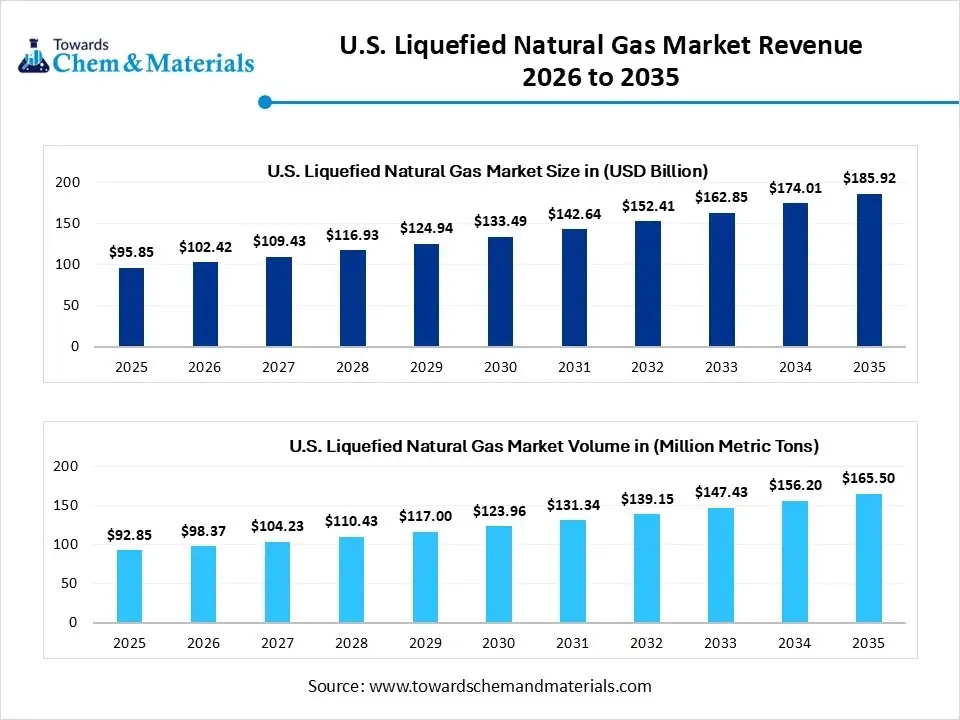
The U.S. liquefied natural gas market size is expected to grow from USD 102.42 billion in 2026 to USD 185.92 billion in 2035, growing at a CAGR of 6.85% from 2026 to 2035. The top key players in the market are ExxonMobil, Chevron, TotalEnergies, Sempra Energy, and Freeport LNG
Content
What is the Current Size and Volume of the U.S. Liquefied Natural Gas Market and Its Projected Growth?
The U.S. liquefied natural gas market size was estimated at USD 95.85 billion in 2025 and is expected to increase from USD 102.42 billion in 2026 to USD 185.92 billion by 2035, growing at a CAGR of 6.85% from 2026 to 2035.In terms of volume, the market is projected to grow from 92.85 million metric tons in 2025 to 165.50 million metric tons by 2035. growing at a CAGR of 5.95% from 2026 to 2035. The growth of the market is driven by the massive production capacity and growing demand for sustainable and environmentally friendly products.
Market Highlights
- By type, the Liquefaction Terminals facilities segment dominated the market share 40.00% in 2025. Liquefaction plants (onshore) hold the dominant market position due to high investment.
- By type, the LNG regasification facilities segment is projected to grow at the fastest CAGR between 2026 and 2035. Increased focus on energy security has boosted the development of regasification projects.
- By End-Use Industry, the Energy & Utilities segment dominated the market share 50.00% in 2025. The surge was driven by rising demand for cleaner energy alternatives.
- By End-Use Industry, the transportation segment is projected to grow at the fastest CAGR between 2026 and 2035. The growth is driven by the growing automotive sector
Market Size and Volume Forecast
- Market Size (2025): USD 95.85 Billion | CAGR (2025–2035): 6.85%
- Market Projected Size (2035): USD 185.92 Billion
- Market Volume (2025): 92.85 Million Metric Tons (MMT) | Volume CAGR (2025–2035): 5.95%
- Market Projected Volume (2035): 165.50 Million Metric Tons (MMT)
- Market Pricing(2025):
- Average Manufacturing Price: USD 5.25/MMBtu
- Average Selling Price: USD 8.75/MMBtu
- Pricing CAGR (2025–2035): 3.29%
Market Overview
What Is The Significance Of The U.S. Liquefied Natural Gas Market?
The U.S. liquefied natural gas (LNG) market is growing significant, having shifted from zero exports to becoming the world’s largest LNG exporter in less than a decade. It enhances global energy security, particularly in Europe and Asia, provides a lower-carbon alternative to coal, and serves as a major economic driver for domestic energy producers. U.S. exports have increased global supply flexibility, often utilizing free-on-board contracts that allow buyers to change destinations, which contrasts with traditional, more rigid contracts.
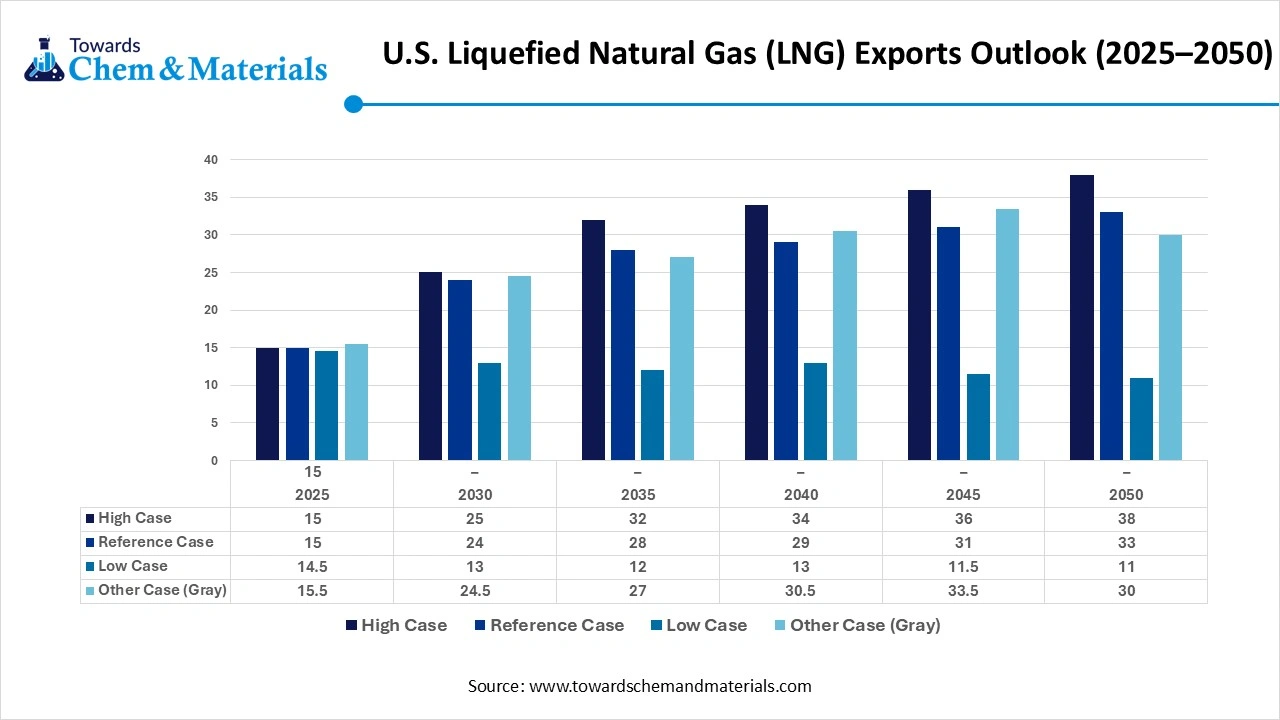
U.S. Liquefied Natural Gas (LNG) Exports Outlook (2025–2050)
Most of the expected increase in U.S. natural gas production is driven by rising demand from international buyers, especially countries importing U.S. liquefied natural gas (LNG). LNG exports are projected to grow steadily through the 2040s, increasing from about 15 billion cubic feet per day (Bcf/d) in 2025 to more than 30 Bcf/d by 2050 in most scenarios.
Export levels in the projections tend to stay close to the Counterfactual Baseline case, but they are highest in the Combination case. In this scenario, policies aimed at reducing emissions from transportation and electricity generation are not implemented. Without these policies, oil consumption remains higher, which pushes up Brent crude oil prices. Since LNG prices are often linked to crude oil prices, U.S. LNG becomes more competitive globally because it is priced based on domestic natural gas markets.
Additionally, lower electricity demand from electric vehicles (EVs) reduces the amount of natural gas needed for power generation. This leaves more natural gas available for export. The lack of power sector policies also allows more efficient combined-cycle power plants to operate at higher levels, which use less natural gas overall. As a result, even more natural gas can be redirected to international markets.
Key Insights
- LNG exports rose sharply from near zero in 2010 to ~15 Bcf/d in 2025.
- Exports accelerated rapidly after 2016 due to new export terminals.
- The high case reaches ~38 Bcf/d by 2050, showing strong global demand growth.
- The reference case stabilizes around 32–33 Bcf/d in the long term.
- The low case declines and stays near ~11–13 Bcf/d, reflecting weaker demand or constraints.
- Projections diverge significantly after 2030, indicating uncertainty in global LNG markets.
Recent Market Growth Trends:
- Infrastructure Expansion: Continued development of new liquefaction terminals like Corpus Christi Stage 3 (Plaquemines LNG) is significantly elevating U.S. export capacity.
- Energy Security & Transition: U.S. LNG is serving as a vital substitute for higher-carbon fuels in Europe and Asia, supporting energy security and decarbonization efforts.
- Production Records: Appalachia production grew by 1.1 Bcf/d in 2025 compared with the increase of just 46 million cubic feet per day Bcf/d in 2024, because the Federal Energy Regulatory Commission increased capacity.
- In 2025, the Haynesville region's production averaged 14.9 Bcf/d, a 4% increase from 2024's annual average. The formation is situated between 10,500 and 13,500 feet deep, whereas wells in the Appalachia region typically range from 4,000 to 8,500 feet deep.(Source: www.eia.gov)
Report Scope
| Report Attributes | Details |
| Market Size in 2025 | USD 201.48 Billion / 226.53 Million Metric Tons |
| Expected Size by 2034 | USD 303.05 Billion/ 349.93 Million Metric Tons |
| Growth Rate from 2026 to 2035 | CAGR 4.64% |
| Base Year of Estimation | 2024 |
| Forecast Period | 2026 - 2035 |
| Segment Covered | By Infrastructure Type, By Application, By End-Use Industry, By Supply Chain Stage, By Contract Type |
| Key Companies Profiled | ExxonMobil, Chevron, TotalEnergies, Sempra Energy, and Freeport LNG |
Key Technological Shifts In The U.S. Liquefied Natural Gas Market:
The market is undergoing a rapid, technology-driven expansion, transforming from zero capacity in 2015 to the world's largest exporter in 2023. Key shifts include widespread adoption of advanced shale extraction, AI-driven terminal optimization, modular liquefaction technology, and efforts to reduce carbon intensity through digitalization and cleaner processes. The industry is moving toward modular liquefaction technology, allowing for faster construction times and smaller-scale, more flexible facilities. This enables faster deployment in remote regions.
Major Growth Challenges in the U.S. Liquefied Natural Gas Market
Major growth challenges in the U.S. liquefied natural gas market include regulatory uncertainty, specifically permitting and methane emission standards, high infrastructure capital costs, and intense pressure to reduce greenhouse gas emissions. Geopolitical volatility, labor shortages, and rising material costs for construction further complicate the expansion of export terminals and pipelines, which hinders the growth of the market. Mitigating environmental impacts, particularly methane leakage during production and transport, is crucial for long-term sustainability.
Major Growth Opportunities in the U.S. Liquefied Natural Gas Market
The market is set for massive growth, with export capacity projected to double, driven by European demand for energy security and Asian demand for cleaner fuel. Key opportunities include constructing new export terminals, expanding infrastructure, developing AI-driven operational technology, decarbonizing the supply chain through carbon capture (CCS), and increasing LNG use for marine bunkering. Opportunities exist in integrating Carbon Capture and Storage (CCS) into LNG plants to reduce methane emissions and supply "lower-carbon" LNG, which fetches premium pricing.
Trade Analysis Of U.S. Liquefied Natural Gas Market: Import & Export Statistics
Top-performing Liquefied Natural Gas Exporters by volume:
- DIAMOND GAS INTERNATIONAL PTE LTD DGI: 15 shipments (21%)
- TOTALENERGIES GAS POWER ASIA PVT LTD: 14 shipments (20%)
- BP Gas Marketing Ltd.: 12 shipments (17%)
U.S. Liquefied Natural Gas Market -- Supply Chain Analysis
LNG Production & Liquefaction
- Liquefied natural gas (LNG) is produced by purifying natural gas and cooling it to cryogenic temperatures for liquefaction, enabling efficient storage and transportation.
- Key players Cheniere Energy, ExxonMobil, Chevron, Sempra Energy
Quality Testing and Certification
- LNG must comply with safety, energy content, storage, and transportation standards, along with environmental regulations.
- Key players: U.S. Department of Energy, Federal Energy Regulatory Commission, International Organization for Standardization, U.S. Environmental Protection Agency.
Distribution to Industrial Users
- LNG is supplied to power generation companies, industrial users, transportation sectors, and export markets for energy applications.
- Key players: Cheniere Energy, Chevron, Sempra Energy.
U.S. Liquefied Natural Gas Regulatory Landscape: Regulations
| Country / Region | Regulatory Body | Key Regulations | Focus Areas | Notable Notes |
| U.S. | Federal Energy Regulatory Commission (FERC); Department of Energy (DOE); Environmental Protection Agency (EPA); Pipeline and Hazardous Materials Safety Administration (PHMSA) | Natural Gas Act; LNG Export Authorization (DOE); National Environmental Policy Act (NEPA); Pipeline Safety Regulations | LNG terminal approvals, export licensing, environmental impact assessment, pipeline safety | FERC oversees siting and construction of LNG terminals, while DOE authorizes exports (especially to non-FTA countries). NEPA mandates environmental impact assessments, and PHMSA regulates pipeline and LNG facility safety. |
Segmental Insights
By Infrastructure Type
LNG Liquefaction Facilities Segment Led the U.S. Liquefied Natural Gas Market in 2025 with the Largest Share
The LNG liquefaction facilities segment dominated the market in 2025, driven by record-high investment and the sanctioning of over 80 billion cubic meters (bcm) of new capacity, cementing its role as a leading global exporter. Infrastructure expansion was bolstered by massive, high-capacity, largely onshore projects. Key projects like Sabine Pass and Corpus Christi enable the U.S. to lead in converting natural gas for global transport. The surge is fueled by the need to export, with the U.S. expected to significantly increase its export capacity within the coming years.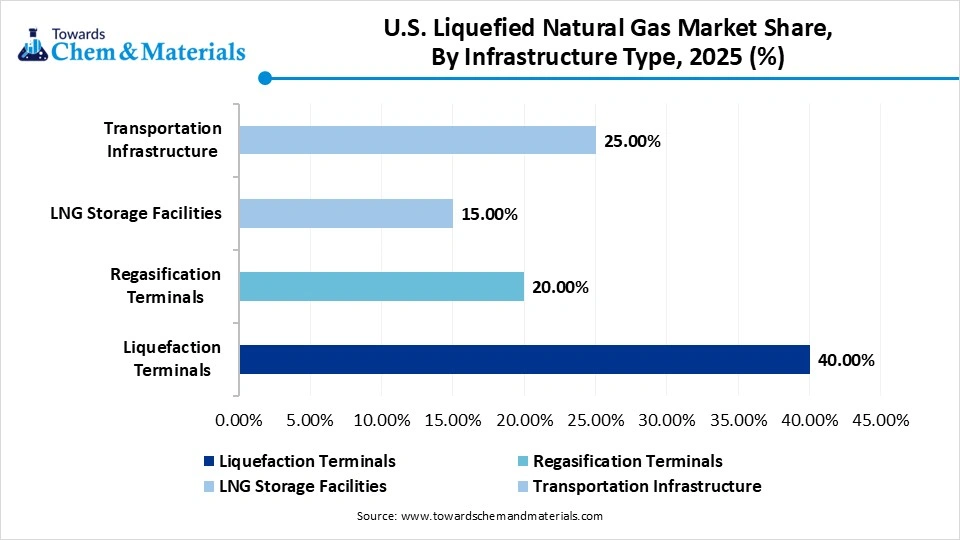
The LNG regasification facilities segment is projected to grow at the fastest CAGR between 2026 and 2035 in the market. The demand is accelerated by the need for cleaner energy, geopolitical factors, and technological advancements in infrastructure. This growth is driven by rising demand for clean energy and increased LNG exports. The rapid deployment of Floating Storage and Regasification Units (FSRUs) offers a flexible and faster alternative to traditional onshore terminals, improving growth metrics.
U.S. Liquefied Natural Gas Market Share, By Infrastructure Type, 2025 (%)
| By Infrastructure Type | Revenue Share, 2025 (%) |
| Liquefaction Terminals | 40.00% |
| Regasification Terminals | 20.00% |
| LNG Storage Facilities | 15.00% |
| Transportation Infrastructure | 25.00% |
- LNG Export Terminals: Export terminals are expected to see continued growth as LNG exports rise. They could hold around 10.00% of the market share in 2025.
- LNG Regasification Equipment: Equipment used in regasification terminals, such as vaporization systems and other technology, may contribute around 5.00% to the overall LNG infrastructure market in 2025.
- LNG Retail/End-User Infrastructure: Retail LNG stations or infrastructure supporting industrial end users (such as for power generation or heavy-duty transportation) could contribute another 5.00% of the market share.
- LNG Bunkering: As LNG is increasingly used as a marine fuel, the LNG bunkering infrastructure could account for around 5.00% of the total market share in 2025, given the growing demand for cleaner marine fuels.
By End-Use Industry
The Industrial Segment Led the U.S. Liquefied Natural Gas Market in 2025 with the Largest Share
The industrial segment dominated the market in 2025. driven by unprecedented export capacity and increased industrial demand for cleaner fuels. Industrial applications significantly dominated consumption, propelled by the urgent shift toward decarbonization in manufacturing and processing. High demand for natural gas in industrial applications, particularly for manufacturing and processing, fueled the sector's leading role in consumption. The surge was driven by rising demand for cleaner energy alternatives and efforts to reduce carbon emissions from industrial activities.
The transportation fuel segment is projected to grow at the fastest CAGR between 2026 and 2035 in the market. Driven by the demand for cleaner alternative fuels and cost-effectiveness. Robust demand for LNG as a clean fuel for buses and trucks is accelerating the sector's growth. The growing adoption of LNG for marine vessel fuel is heavily contributing to the market expansion. LNG's competitiveness against traditional fuels, combined with its lower carbon footprint, is making it a preferred choice over conventional diesel and heavy fuel oils.
U.S. Liquefied Natural Gas Market Share, By End-Use Industry, 2025 (%)
| By End-Use Industry | Revenue Share, 2025 (%) |
| Energy & Utilities | 50.00% |
| Industrial Sector | 22.00% |
| Transportation & Logistics | 18.00% |
| Commercial Sector | 10.00% |
- Energy and Utilities: Dominating the market with a 50.00% share, this sector's demand for LNG is driven by the need for cleaner energy alternatives and the growing adoption of LNG for power generation and storage.
- Industrial: Contributing 22.00%, industries such as chemicals, manufacturing, and refineries rely on LNG for its cost-effectiveness, lower emissions, and as a key component in industrial processes.
- Transportation and Logistics: Accounting for 18.00%, LNG is increasingly used in the transportation sector for heavy-duty trucks, shipping, and rail, due to its lower carbon emissions compared to diesel and gasoline.
- Commercial: Making up 10.00%, the commercial sector uses LNG mainly for heating, cooling, and power generation in large-scale buildings and facilities, as well as for transportation fleets.
By Supply Chain Stage
The U.S. liquefied natural gas (LNG) market comprises multiple supply chain stages, with upstream exploration and production providing the foundational natural gas feedstock, as seen in global LNG supply chain analyses. Midstream activities including pipeline transportation, storage, and liquefaction terminals represent the largest share of LNG supply chain investments and infrastructure due to the capital"‘intensive nature of gathering, processing, and export facilities that connect producers to global markets.
Downstream activities, such as regasification, distribution, and commercial sales, capture a similar portion to upstream reflecting processing and delivery roles. Within the U.S. natural gas market overall, commercial end"‘use (e.g., buildings, services) historically represents total domestic natural gas consumption, dwarfing but distinct from LNG export volumes which have surged to position the U.S. as the world’s largest LNG exporter.
U.S. Liquefied Natural Gas Market Share, By Supply Chain Stage, 2025 (%)
| By Supply Chain Stage | Revenue Share, 2025 (%) |
| Upstream | 30.00% |
| Midstream | 45.00% |
| Downstream | 25.00% |
| Commercial Sector | 10.00% |
- Upstream Segment:Revenue Share: 30.00%.Activities include exploration, production, and extraction of natural gas.
- Midstream Segment:Revenue Share: 45.00%.Activities include transportation, storage, and distribution of LNG, crucial for the infrastructure.
- Downstream Segment:Revenue Share: 25.00%.Activities include the processing, liquefaction, and distribution of LNG to end consumers, including industrial, residential, and commercial sectors.
- Commercial Sector:Contribution to Total Revenue: 10.00%This includes LNG used in non-industrial commercial applications such as power generation, transportation, and hospitality.
By Contract Type
The U.S. LNG market’s commercial structure encompasses a variety of contract types that govern how liquefied natural gas is sold and shipped internationally. Historically, long"‘term contracts often spanning 10–20+ years have underpinned major U.S. LNG export projects by providing the revenue certainty needed to finance large liquefaction facilities, and these long"‘term deals continue to dominate sanctioned export capacity globally. However, market dynamics have been shifting toward greater pricing flexibility and destination"‘flexible contracts as buyers seek more adaptability.
Alongside traditional long"‘term agreements, spot market transactions have grown in prominence, allowing LNG cargoes to be traded close to delivery based on real"‘time price signals and supply demand conditions. Short"‘term contracts, typically defined as deals of a few months to a few years, provide an intermediate structure that bridges the rigidity of long"‘term commitments with the agility of spot trading, and U.S. LNG producers increasingly leverage all three contract types to meet diverse buyer preferences and market conditions.
U.S. Liquefied Natural Gas Market Share, By Contract Type, 2025 (%)
| By Contract Type | Revenue Share, 2025 (%) |
| Long-term Contracts | 55.00% |
| Spot Market | 25.00% |
| Short-term Contracts | 20.00% |
- The U.S. Liquefied Natural Gas market in 2025 is expected to be dominated by long-term contracts, making up 55.00% of the revenue share. These contracts provide stability and predictability for both producers and buyers, ensuring consistent supply over extended periods.
- The spot market will contribute 25.00% to the total market share in 2025. It offers flexibility to buyers and sellers, enabling transactions at prevailing market prices for shorter durations.
- Short-term contracts are projected to account for 20.00% of the market share in 2025. This segment caters to those looking for more flexible terms, typically with a duration ranging from one to five years.
Recent Developments
- In March 2026, Venture Global and Vitol announced a binding agreement for a five-year, 1.5 million tonnes per annum (MTPA) LNG supply deal. This deal strengthens Venture Global’s portfolio-based supply approach, allowing it to diversify contract tenors and expand its market presence alongside the CP2 LNG project development.(Source: www.sttinfo.fi)
- In January 2026, The Institute for Energy Economics and Financial Analysis (IEEFA) launched an LNG export tracker showing North American LNG export capacity is set to double by 2030, with most shipments destined for Europe. The analysis indicates this rapid expansion has increased regional price volatility.(Source : ieefa.org)
Top players in the U.S. Liquefied Natural Gas Market & Their Offerings:
- Cheniere Energy: Cheniere Energy is the largest LNG exporter in the United States, operating major facilities such as Sabine Pass and Corpus Christi. The company focuses on liquefaction, export, and long-term supply contracts with global buyers, supplying Europe and Asia with large-scale LNG volumes.
- Freeport LNG Development, L.P.: Freeport LNG operates one of the largest LNG export terminals in Texas, converting natural gas into LNG for global markets. The company plays a key role in U.S. export capacity and supplies LNG to international utilities and energy firms.
- Sempra Infrastructure: Sempra Infrastructure develops and operates LNG export terminals such as Cameron LNG. The company provides liquefaction, storage, and export solutions while supporting long-term LNG supply agreements and global energy trading.
- Venture Global LNG: Venture Global focuses on low-cost LNG production and export, operating facilities like Calcasieu Pass and developing Plaquemines LNG. The company is rapidly expanding its capacity to meet growing global demand for U.S. LNG.
- Tellurian Inc.: Tellurian is involved in LNG infrastructure development, particularly the Driftwood LNG project. The company focuses on integrated natural gas production, liquefaction, and export solutions for global energy markets.
- British Petroleum (BP) p.l.c.
- Chevron Corporation
- China Petroleum & Chemical Corporation
- Eni SpA
- Equinor ASA
- Exxon Mobil Corporation
- Gazprom Energy
- PetroChina Company Limited
- Royal Dutch Shell PLC
- Total S.A.
Segments Covered:
By Infrastructure Type
- Liquefaction Terminals
- Onshore Liquefaction
- Floating LNG (FLNG)
- Regasification Terminals
- Onshore Regasification
- Offshore Regasification (FSRU)
- LNG Storage Facilities
- Above-ground Tanks
- Underground Storage
- Transportation Infrastructure
- LNG Carriers
- LNG Trucks
- Rail LNG Transport
By Application
- Power Generation
- Base Load Power
- Peak Shaving Plants
- Industrial Use
- Chemicals & Petrochemicals
- Metal & Manufacturing
- Residential & Commercial
- Heating
- Cooking
- Transportation Fuel
- Heavy-duty Trucks
- Marine Bunkering
- Rail Transport
By End-Use Industry
- Energy & Utilities
- Industrial Sector
- Transportation & Logistics
- Commercial Sector
By Supply Chain Stage
- Upstream
- Natural Gas Extraction
- Gas Processing
- Midstream
- Liquefaction
- Storage
- Transportation
- Downstream
- Regasification
- Distribution
By Contract Type
- Long-term Contracts
- Spot Market
- Short-term Contracts
FAQ's
Question 1 : What are the key growth drivers of the U.S. liquefied natural gas market?
Answer : The growth of the U.S. LNG market is driven by increased export capacity, rising global demand for cleaner energy, and technological advancements in liquefaction and regasification infrastructure.
Question 2 : How is technology disrupting the U.S. liquefied natural gas market?
Answer : The adoption of modular liquefaction technology, AI-driven terminal optimization, and carbon capture systems is significantly transforming the U.S. LNG market, enabling faster construction and reducing carbon emissions.
Question 3 : What are the major regulatory challenges in the U.S. liquefied natural gas market?
Answer : Regulatory uncertainty around permitting, methane emission standards, and high infrastructure capital costs pose significant challenges to the growth of the U.S. LNG market.
Question 4 : Who are the leading companies in the U.S. liquefied natural gas market?
Answer : Key players in the U.S. LNG market include Cheniere Energy, Freeport LNG, Sempra Infrastructure, and Venture Global LNG, with major facilities and global export capacity.
Meet the Team

Saurabh Bidwai
Principal Consultant
Saurabh Bidwai, a B.Tech Chemical Engineering graduate with 4+ years of experience, specializes in specialty chemicals, commodity chemicals, and engineered materials, offering valuable insights into market trends and emerging opportunities.

Aditi Shivarkar
Reviewed By
Aditi Shivarkar, with 14+ years in Chemical and Materials market research, specializes in Chemical and Materials. She ensures accurate, actionable insights, driving Towards Chemicals And Materials Analytics and Consulting excellence in industry trends and sustainability.