
U.S. Oil & Gas Electrification Market Size, Share, Growth, Report 2026 to 2035
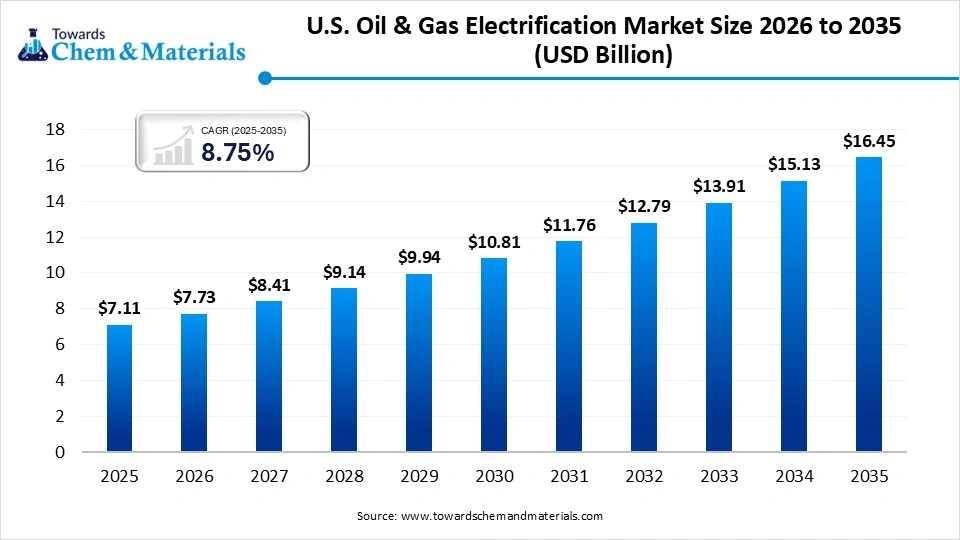
The U.S. oil & gas electrification market is expected to witness significant growth, expanding from USD 8.41 billion in 2026 to USD 16.45 billion by 2035 at a CAGR of 8.75%. The study covers in-depth market size evaluation, segmentation data, and regional performance analysis. It further highlights key company profiles, competitive strategies, value chain analysis, trade statistics, and extensive data on manufacturers and suppliers operating in the market.
Content
U.S. Oil & Gas Electrification Market Trends, Growth and Market Size Analysis
The U.S. oil & gas electrification market size was estimated at USD 7.11 billion in 2025 and is expected to be worth around USD 16.45 billion by 2035, exhibiting a compound annual growth rate (CAGR) of 8.75% over the forecast period from 2026 to 2035. This report provides a complete analysis of market size along with detailed segment-wise data by application, technology, and end-use. It also includes regional insights across key U.S. regions, along with comprehensive profiles of leading companies, competitive landscape analysis, value chain assessment, trade data, and detailed manufacturer and supplier insights.
Key Takeaways
- By electrification type, the onshore electrification segment dominated the market with the largest share of 46.00% in 2025. The dominance of the segment can be attributed to the rise in the number of onshore fields.
- By electrification type, the offshore electrification segment is expected to grow at the fastest CAGR of 9.4% over the forecast period. The growth of the segment can be credited to the increasing investments in subsea infrastructure.
- By application, the upstream segment dominated the market with 48.00% share in 2025 and is expected to grow at the fastest CAGR of 8.9% over the forecast period. The dominance and growth of the segment are owed to the rapid electrification.
- By power source, the grid electricity segment dominated the market with 42.00% share in 2025. The dominance of the segment can be credited to the extensive developments in existing infrastructure.
- By power source, the renewable energy segment is expected to grow at the fastest CAGR of 9.8% during the forecast period. The growth of the segment can be linked to the ongoing implementation of decarbonization initiatives.
- By end user, the oil companies segment dominated the market with the largest share of 38.00% in 2025. The dominance of the segment is due to ambitious emission targets.
- By end user, the integrated energy companies segment is expected to grow at the fastest CAGR of 9.2% over the projected period. The growth of the segment can be attributed to the strong investments in infrastructure.
Market Size and Volume Forecast
- Market Size (2025): USD 7.11 Billion | CAGR (2026–2035): 8.75%
- Market Projected Size (2035): USD 16.45 Billion
- Market Volume (2025): 42.50 GW Installed Electrification Capacity | Volume CAGR (2026–2035): 7.95%
- Market Projected Volume (2035): 91.33 GW Installed Electrification Capacity
- Market Pricing (2025):
- Average Manufacturing Price: USD 1,185/kW
- Average Selling Price: USD 1,450/kW
- Pricing CAGR (2025–2035): 3.8%
Market Overview
The market encompasses replacing hydrocarbon-powered equipment with electric-driven machinery across upstream, midstream, and downstream operations to minimize emissions and overall operational costs. The primary driver propelling the expansion of the market includes strict government regulations focused on decarbonization to achieve net zero emissions and the pursuit of operational efficiency.
U.S. Oil & Gas Electrification Market Trends
- The ongoing enforcement of strict carbon emissions regulations is the latest trend in the market, shaping positive market growth. Regulatory bodies in marine basins are increasingly implementing strict limits on greenhouse gases, requiring the replacement of traditional gas turbines with low-carbon electrical power to maintain compliance.
- The rapid advancements in High-Voltage Alternating Current (HVAC) and High-Voltage Direct Current (HVDC) subsea cables allow for smooth long-distance power transmission from onshore grids, leading to market expansion soon. Cutting-edge Lithium-ion and flow batteries are increasingly becoming crucial for managing the intermittency of renewable energy in microgrids.
- The expanding offshore and oil and gas operations are another major trend in the market, driving market growth. Electrification can enhance energy efficiency and minimize the need for gas and diesel engines. These will create lucrative opportunities in the market for innovative electrification solutions to fulfil the growing energy needs.
How Cutting Edge Technologies are revolutionizing the U.S. Oil & Gas Electrification Market?
Advanced technologies such as IoT sensors, AI-powered automation, and microgrids are transforming the market by shifting from diesel to electric power, minimizing emissions, and increasing overall efficiency. Furthermore, robotics is rapidly being used to handle tedious tasks like pipeline inspection, which enhances safety and reduces human risks in dangerous environments.
Trade Analysis of the Industrial U.S. Oil & Gas Electrification Market: Import & Export Statistics
- U.S. exports of natural gas plant liquids (NGPL) hit 3.1 million barrels per day (b/d) in 2025, a 7% increase over the previous year.
- In 2024, U.S. petroleum product imports dropped 11% from 2023 levels, constituting 16% of total energy imports, while exports rose 8% to represent 37% of total energy exports.
- U.S. natural gas exports achieved a record high in 2024, representing about 25% of total energy exports by energy content, continuing a nearly uninterrupted growth streak since 2014.
- In 2024, the U.S. exported 20% of its dry natural gas. Over the past decade, domestic production and exports outpaced both local demand and imports.
- In 2024, Mexico led as the primary buyer of U.S. crude oil, petroleum products, and natural gas, while India took the top spot for U.S. coal exports.
U.S. Oil & Gas Electrification Market Supply Chain Analysis
Feedstock Procurement
It refers to the strategic acquisition of clean electricity and renewable natural gas (RNG) to replace conventional fossil-fuel-powered machinery at drilling, production, and refining sites.
- Major Players: ExxonMobil, Chevron
Chemical Synthesis and Processing
It refers to the shift of downstream refining and petrochemical operations from fossil-fuel-based energy to electrical power.
- Major Players: DuPont, Albemarle
Packaging and Labelling
It includes the specialized industrial standards and regulatory needs for transporting and identifying electrical infrastructure utilized in volatile oilfield environments.
- Major Players: Aker Solutions, Bechtel
Regulatory Compliance and Safety Monitoring
It includes the crucial l framework of adhering to federal, state, and local standards while using AI-driven, digital, and IoT-enabled technologies, ensuring operational safety.
- Major Players: Schneider Electric, Honeywell International Inc
U.S. Oil & Gas Electrification Market's Regulatory Landscape: Regulations
| State/Region | Key Regulations |
| California | Clean Electricity Targets: Targeting 100% clean electricity by 2045, California has the most stringent standards for field operations, often exceeding federal EPA requirements. |
| Texas | New rules from the Railroad Commission of Texas require operators of wells inactive for 10+ years to remove all associated electric power equipment (unless owned by a utility) when applying for plugging extensions. |
| New Mexico | The Energy, Minerals and Natural Resources Department is focusing on a 45% reduction in emissions by 2030, encouraging operators to transition from gas-powered to electric field equipment. |
Segmental Insights
Electrification Type Insights
The Onshore Electrification Segment Dominated The Market With The Largest Share of 46.00% In 2025
The onshore electrification segment dominated the market with the largest share of 46.00% in 2025. The dominance of the segment can be attributed to the rise in the number of onshore fields and extensive grid accessibility, which optimizes implementation. Cost efficiency also supports electrification adoption.
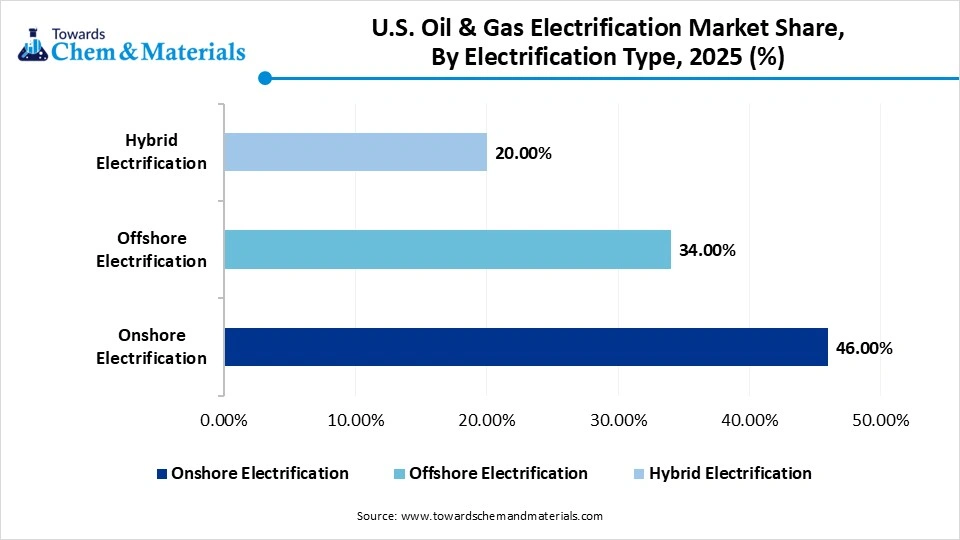
The offshore electrification segment held the second largest share of 34.00% in 2025 and is expected to grow at the fastest CAGR of 9.4% over the forecast period. The growth of the segment can be credited to the increasing investments in subsea infrastructure and the ongoing implementation of emission reduction targets. Also, its integration with the offshore wind fuels segment expansion.
The hybrid electrification segment held the third largest share of 20.00% in 2025. The growth of the segment can be driven by its flexibility in energy sourcing and integration of renewable materials. Moreover, the overall cost optimization improved segment growth further.
Application Insights
The Upstream Segment Dominated The Market With 48.00% Share In 2025
The upstream segment dominated the market with 48.00% share in 2025 and is expected to grow at the fastest CAGR of 8.9% over the forecast period. The dominance and growth of the segment is owed to the rapid electrification of drilling and production, along with the ongoing implementation of emission reduction. Furthermore, artificial life systems increase electricity usage.
The midstream segment held the second largest share of 26.00% in 2025. The growth of the segment is due to a surge in infrastructure upgrades and growing power demand from the compressor stations. Pipeline electrification also improves efficiency.
The downstream segment held 26.00% market share in 2025. The growth of the segment can be attributed to the rapid modernization of refineries and advancements in technology, which enhance overall energy efficiency. The expansion of the petrochemical sector further propels segment growth.
U.S. Oil & Gas Electrification Market Share By Application, 2025 (%)
| By Application | Revenue Share, 2025 (%) |
| Upstream | 48.00% |
| Midstream | 30.00% |
| Downstream | 22.00% |
Power Source Insights
The Grid Electricity Segment Dominated The Market With 42.00% Share In 2025
The grid electricity segment dominated the market with 42.00% share in 2025. The dominance of the segment can be credited to the extensive developments in existing infrastructure, coupled with the availability of a reliable power supply. In addition, the cost-effectiveness of grid power supply will drive market growth soon.
The renewable energy segment held the second largest share of 22.00% in 2025 and is expected to grow at the fastest CAGR of 9.8% during the forecast period. The growth of the segment can be linked to the ongoing implementation of decarbonization initiatives, which fuel the integration of renewable sources. Government incentives are also impacting positive segment growth shortly.
The gas-to-power systems segment held the third largest share of 20.00% in 2025. The growth of the segment can be driven by growing utilization of associated gas, which reduces flaring emissions. Also, On-site generation supports reliability, leading to further segment growth.
The hybrid power systems segment held the fourth largest share of 16.00% in 2025. The growth of the segment is owed to the increasing demand to reduce emissions and enhance operational efficiency in remote areas. Hybrid systems also minimize dependence on diesel generators.
U.S. Oil & Gas Electrification Market Share By Power Source, 2025 (%)
| By Power Source | Revenue Share, 2025 (%) |
| Grid Electricity | 42.00% |
| Renewable Energy | 22.00% |
| Gas-to-Power Systems | 20.00% |
| Hybrid Power Systems | 16.00% |
End-User Insights
The Oil Companies Segment Dominated The Market With The Largest Share Of 38.00% In 2025
The oil companies segment dominated the market with the largest share of 38.00% in 2025. The dominance of the segment is due to ambitious emission targets and large upstream operations. Its cost efficiency also supports investments in the oil sector.
The integrated companies segment held the second largest share of 28.00% in 2025 and is expected to grow at the fastest CAGR of 9.2% over the projected period. The growth of the segment can be attributed to the strong investments in infrastructure development, coupled with the enforcement of sustainability goals.
The gas companies segment held the third largest share of 22.00% in2025. The growth of the segment can be credited to the growing gas demand in the country and ongoing pipeline electrification. Major players are increasingly adopting electric technologies to reduce Scope 1 and 2 emissions.
The service providers segment held the fourth largest share of 12% in 2025. The growth of the segment can be linked to the increasing upstream shale investment and the ongoing transition towards sustainability to minimize emissions. Major providers give services for power generation, distribution, and automation.
U.S. Oil & Gas Electrification Market Share By End-User 2025 (%)
| By End-User | Revenue Share, 2025 (%) |
| Oil Companies | 38.00% |
| Gas Companies | 22.00% |
| Integrated Energy Companies | 28.00% |
| Service Providers | 12.00% |
Country Insights
The growth of the U.S. oil and gas electrification market is being driven by a mix of economic, environmental, and technological factors. Traditionally, upstream and midstream operations relied heavily on diesel engines and gas turbines to power drilling rigs, pumps, and compressors. However, companies are increasingly shifting toward electrified systems such as electric drilling rigs, electric submersible pumps, and grid-powered or renewable-powered infrastructure because they offer higher efficiency, lower operating costs over time, and reduced maintenance requirements.
The growth of the market in the country can be driven by an increasing demand to minimize operational emissions, enhance efficiency, and adopt cost-effective technologies. Furthermore, ongoing investment in electrical infrastructure at manufacturing, compression, and refining sites is crucial for promoting the shift towards electrification.
Recent Developments
- In March 2026, Tesla is set to enter the UK energy market as a new competitor after its unit, Tesla Energy Ventures, was granted an electricity supply license by regulator Ofgem. The move, which follows an application process that began in July, comes at a time when consumers are increasingly concerned about rising energy bills.
U.S. Oil & Gas Electrification Market Companies
- ABB: ABB is a leading technology partner in the oil and gas electrification market, providing integrated solutions that enhance efficiency, safety, and decarbonization from extraction to refining.
- Aker Solutions: Aker Solutions is a major player in oil and gas electrification, focusing on reducing offshore and onshore emissions by replacing gas turbines with power from shore or renewables.
U.S. Oil & Gas Electrification Market Companies
- BP
- Chevron
- Equinor
- Exxon Mobil
- LS Cable
- Nexans
- Prysmian
- Shell
- Siemens
- Southwire
- SLB
- TotalEnergies
- ZTT
U.S. Oil & Gas Electrification Market Segments Covered in the Report
By Electrification Type
- Onshore Electrification
- Wellhead Electrification
- Processing Facilities Electrification
- Offshore Electrification
- Platform Electrification
- Subsea Electrification
- Hybrid Electrification
- Grid + Renewable Integration
- Diesel + Electric Hybrid Systems
By Equipment
- Electric Motors
- Low Voltage Motors
- Medium Voltage Motors
- High Voltage Motors
- Variable Frequency Drives (VFDs)
- Transformers
- Switchgear
- Power Distribution Systems
- Energy Storage Systems
- Battery Storage
- Hybrid Storage
By Application
- Upstream
- Drilling Operations
- Artificial Lift Systems
- Enhanced Oil Recovery (EOR)
- Midstream
- Pipeline Electrification
- Compressor Stations
- Downstream
- Refining Processes
- Petrochemical Plants
By Power Source
- Grid Electricity
- Renewable Energy
- Solar
- Wind
- Gas-to-Power Systems
- Hybrid Power Systems
By End-User
- Oil Companies
- Gas Companies
- Integrated Energy Companies
- Service Providers
By Country
- Midwest
- Northeast
- South
- West
FAQ's
Question 1 : Which prime factors are stimulating the growth of the U.S. oil & gas electrification market?
Answer : Rising population, urbanization, and industrialization across the country are the major factors driving market growth.
Question 2 : What are the applications of the U.S. oil & gas electrification market?
Answer : The U.S. oil & gas electrification market focuses on replacing fossil fuel-powered machinery with electric alternatives to reduce Scope 1 and 2 emissions, cut operating costs, and meet ESG goals. Key applications include onshore/offshore rig electrification, electric fracturing (e-frac), powering compressor stations, and electrifying infrastructure for midstream operations.
Question 3 : Which segment is expected to grow the fastest?
Answer : The offshore electrification segment is projected to grow at the fastest CAGR of 9.4%, supported by rising investments in subsea infrastructure and offshore wind integration.
Question 4 : Which application segment leads the market?
Answer : The upstream segment leads the market with 48.00% share in 2025 and is also expected to grow the fastest due to increased electrification of drilling and production operations.
Meet the Team

Saurabh Bidwai
Principal Consultant
Saurabh Bidwai, a B.Tech Chemical Engineering graduate with 4+ years of experience, specializes in specialty chemicals, commodity chemicals, and engineered materials, offering valuable insights into market trends and emerging opportunities.

Aditi Shivarkar
Reviewed By
Aditi Shivarkar, with 14+ years in Chemical and Materials market research, specializes in Chemical and Materials. She ensures accurate, actionable insights, driving Towards Chemicals And Materials Analytics and Consulting excellence in industry trends and sustainability.