
U.S. Oxo Alcohols Market Size, Share, Growth, Report 2026 to 2035
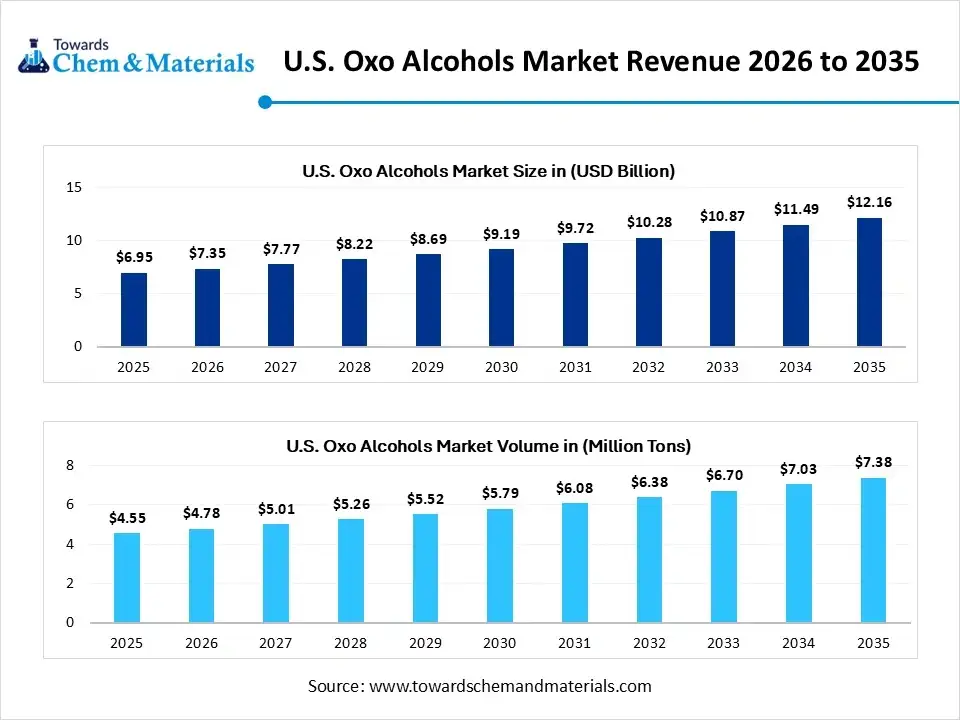
The U.S. oxo alcohols market is projected to reach a valuation of USD 7.35 billion in 2026. Following a period of stabilization, the market is expected to expand to USD 12.16 billion by 2035, maintaining a CAGR of 5.75%. Growth is primarily fueled by rising demand for plasticizers, paints, and coatings within the construction and automotive sectors.Key industry players including BASF SE, Eastman Chemical Company, and Dow are increasingly investing in bio-based feedstocks and digital automation to enhance sustainability and operational efficiency.
Content
What is the current U.S. Oxo Alcohols Market Size and Share?
The U.S. oxo alcohols market size was valued at USD 12.16 billion in 2025, is estimated to reach USD 7.35 billion in 2026, and is projected to reach USD 12.16 billion by 2035, exhibiting a compound annual growth rate (CAGR) of 5.75% over the forecast period from 2026 to 2035. In terms of volume, the U.S. oxo alcohols market is projected to grow from 6.95 million tons in 2025 to 12.16 million tons by 2035. growing at a CAGR of 5.75% from 2026 to 2035.
The growing manufacturing of plasticizers and the increasing need for paints & coatings drive the market growth.
Key Takeaways
- By product type, the 2-ethylhexanol segment held approximately a 37% share in the U.S. oxo alcohols market in 2025.
- By product type, the iso-butanol segment is expected to grow at the fastest CAGR in the market during the forecast period.
- By application, the plasticizers segment held approximately a 31% share in the market in 2025.
- By application, the acrylates segment is expected to grow at the fastest CAGR in the market during the forecast period.
- By production process, the hydroformylation segment held approximately a 58% share in the market in 2025.
- By production process, the oxidation segment is expected to grow at the fastest CAGR in the market during the forecast period.
Market Size and Volume Forecast
- Market Estimated Size (2025): USD 6.95 Billion | CAGR (2026–2035): 5.75%
- Market Projected Size (2035): USD 12.16 Billion
- Market Estimated Volume (2025): 4.55 Million Tons | Volume CAGR (2026–2035): 4.95%
- Market Projected Volume (2035): 7.38 Million Tons
- Pricing Data (2025):
- Average Manufacturing Price (2025): USD 1,420/Ton
- Average Selling Price (2025): USD 1,775/Ton
- Pricing CAGR (2026–2035): 2.25%
What are Oxo Alcohols?
The U.S. oxo alcohols market growth is driven by the growing development of infrastructure projects, increasing manufacturing of coatings & adhesives, rising need for paints, and increasing demand for plasticizers.
Oxo alcohols are alcohols that are prepared using synthesis gas and olefins to produce an aldehyde intermediate. The manufacturing process for oxo alcohols is aldol condensation, hydroformylation, and hydrogenation. The examples of oxo alcohols are iso-nonanol, N-butanol, 2-ethylhexanol, iso-decyl alcohol, and iso-butanol.
What are the Different Types of Oxo Alcohols?
| Oxo Alcohols | Formula | Applications | Producers |
| n-Butanol | C4H9OH |
|
|
| Iso-Butanol | C4H10O |
|
|
| 2-Ethylhexanol | C8H18O |
|
|
| Isononyl Alcohol | C9H20O |
|
|
| 2-Propylheptanol | C10H22O |
|
|
U.S. Oxo Alcohols Market Outlook:
- Industry Growth Overview: Between 2025 and 2034, the industry is expected to see accelerated growth in paints, coatings, and adhesives. The growing end-user sectors like construction, automotive, and consumer goods increase demand for oxo alcohols.
- Sustainability Trends: Sustainability is reshaping the U.S. oxo alcohols landscape, with rising demand for bio-based oxo alcohols, green chemistry, low-VOC adhesives, and low-VOC coatings. For instance, BASF launched a bio-based oxo alcohols product range for automotive coatings.
- Major Investors: Private companies and strategic investors are heavily investing in the oxo alcohols for the development of sustainable technologies and product innovation. Companies like Evonik Industries AG, BASF SE, and Eastman Chemical Company are majorly investing in oxo alcohols.
Key Technological Shifts in the U.S. Oxo Alcohols Market:
The market is undergoing key technological shifts driven by the demand for sustainability, minimizing waste, and regulatory compliance. One of the most significant transformations is that sustainable oxo alcohol production helps to reduce carbon footprints and minimizes waste production.
The growing adoption of bio-based feedstock and advanced catalysis processes makes sustainable oxo alcohol, which lowers the consumption of energy. The integration of automation and digital technologies increases operational efficiency and enhances consistency.
Trade Analysis of the U.S. Oxo Alcohols Market: Import & Export Statistics
- The United States exported 1,052 shipments of n-butanol.(Source: www.volza.com)
- From May 2024 to April 2025, the United States exported 451 shipments of n-butanol.(Source: www.volza.com)
- The United States exported 903 shipments of 2-ethylhexanol.(Source: www.volza.com)
- The United States exported 915 shipments of iso-butanol.(Source: www.volza.com)
U.S. Oxo Alcohols Market Value Chain Analysis
- Feedstock Procurement: The feedstock procurement for oxo alcohols includes olefins like butylene, propylene, & ethylene, and syngas.
- Chemical Synthesis and Processing: The chemical synthesis and processing involve methods like hydroformylation or the Oxo process and hydrogenation.
- Regulatory Compliance and Safety Monitoring: The regulatory compliance and safety monitoring covers areas like chemical registration, product safety, environmental standards, and workplace safety.
Report Scope
| Report Attributes | Details |
| Market Size in 2026 | USD 7.35 Billion |
| Expected Size by 2035 | USD 12.16 Billion |
| Growth Rate from 2025 to 2034 | CAGR 5.75% |
| Base Year of Estimation | 2025 |
| Forecast Period | 2025 - 2035 |
| Segment Covered | By Product Type, By Application, By Production Process, |
| Key Companies Profiled | ExxonMobil Chemical, LG Chem, Hanwha Chemical Corporation, Grupa Azoty ZAK S.A., Andhra Petrochemicals, BAX Chemicals, Elekeiroz, Ningbo Lucky Chemical Industry, Jiahua Chemistry, Jiangyin Huayuan Chemical, Wuhan Jihechang, Oxea GmbH, Perstorp Holding AB, Sekab BioFuels & Chemicals AB, Shell Chemicals |
Market Opportunity
Growing Construction Activities Open New Growth Avenues
The rapid urbanization and growing construction activities in the United States increase demand for oxo alcohols. The growing investment in infrastructure development and the rise in residential construction activities increase the adoption of oxo alcohols.
The increasing manufacturing of pipes, flexible wallboard, and cables increases the adoption of 2-ethylhexanol. The increasing need for coatings & adhesives in construction projects requires oxo alcohols.
The growth in infrastructure development and the high need for paints increase the demand for plasticizers that require oxo alcohols. The increasing need for construction materials like cables, flooring, pipes, and wall panels increases demand for oxo alcohols. The growing construction activities create an opportunity for the growth of the market.
Market Challenge
Fluctuating Raw Material Prices Create Hurdles in Market Growth
With the several benefits of the Oxo alcohols in the United States, the fluctuating raw material prices restrict the market growth. The volatility in the prices of petrochemical feedstocks like natural gas & crude oil increases the cost. The geopolitical events, such as conflicts, trade restrictions, wars, sanctions, and international tensions, increase the raw material cost. The disruptions in supply chains and long-term contracts increase the cost. The fluctuating raw material prices hamper the growth of the U.S. oxo alcohols market.
Country Insights
South U.S. Oxo Alcohols Market Trends
The South region dominated the market with approximately 40% share in 2025. The well-established manufacturing infrastructure and growing industrial activities increase demand for oxo alcohols. The growing utilization of products like plasticizers, paints, and coatings increases the adoption of oxo alcohols. The growing production of speciality chemicals and the increasing need for building materials increase the adoption of oxo alcohols. The growing manufacturing of vehicles and the rise in construction activities increase demand for oxo alcohols, driving the overall market growth.
West U.S. Oxo Alcohols Market Trends
The West region experiences the fastest growth in the market during the forecast period. The increasing industrialization and the rise in manufacturing activities increase the adoption of oxo alcohols. The growing activities like manufacturing automotive components, flooring, and roofing increase demand for plasticizers that require oxo alcohols. The increasing manufacturing of solvents and adhesives requires oxo alcohols, supporting the overall market growth.
Segmental Insights
Product Type Insights
Why the 2-Ethylhexanol Segment Dominates the U.S. Oxo Alcohols Market?
The 2-ethylhexanol (2-EH) segment dominated the market with approximately 37% share in 2025. The growing manufacturing of plasticizers like dioctyl phthalate and others increases demand for 2-EH. The growing need for flexible PVC and the increasing manufacturing of automotive interior components increase the adoption of 2-EH. It is cost-effective and possesses high solvency property. The growing demand for 2-EH in applications like packaging, lubricants, construction, and consumer goods drives the market growth.
The iso-butanol segment is the fastest-growing in the market during the forecast period. The growing manufacturing of adhesives, paints, and varnishes increases the adoption of iso-butanol. The increasing production of isobutyl acetate and the rising need for biofuel increase the adoption of iso-butanol. The growing demand for paint cleaners and automotive polishes requires iso-butanol. The growth in construction activities and the expansion of the packaging sector increase the adoption of iso-butanol, supporting the overall market growth.
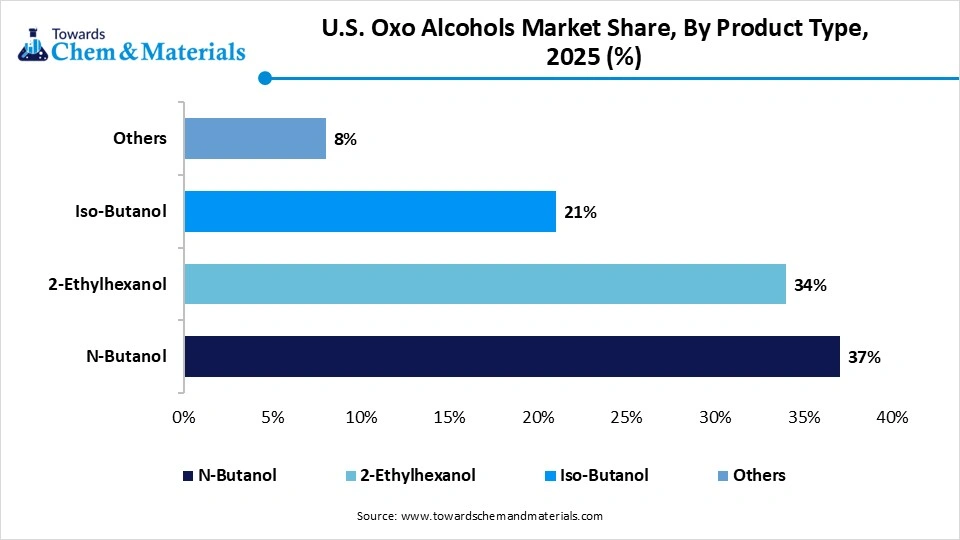
U.S. Oxo Alcohols Market Share, By Product Type , 2025 (%)
| By Product Type | Revenue Share, 2025 (%) |
| N-Butanol | 37% |
| 2-Ethylhexanol | 34% |
| Iso-Butanol | 21% |
| Others | 8% |
- N-Butanol: N-Butanol is one of the most widely used oxo alcohols, primarily due to its versatile applications in coatings, plastics, and adhesives, as well as in the production of plasticizers and solvents. N-Butanol holds 37% of the market share.
- 2-Ethylhexanol: 2-Ethylhexanol is highly demanded in the production of plasticizers for PVC, as well as in the manufacturing of lubricants and coatings. This product accounts for 34% of the market share due to its extensive industrial applications.
- Iso-Butanol: Iso-Butanol is used in solvents and as a key intermediate in the production of various chemicals, including plasticizers, butyl acrylate, and butyl rubber. It holds 21% of the market share, being a widely used oxo alcohol in various sectors.
- Others: This category includes other specialized oxo alcohols used in niche applications, such as in the production of lubricants, resins, and other specialty chemicals. The "Others" segment represents 8% of the market share.
Application Insights
Which Application Held the Largest Share in the U.S. Oxo Alcohols Market?
The plasticizers segment held the largest revenue share of approximately 31% in the market in 2025. The growing residential construction activities and the development of infrastructure projects increase demand for plasticizers for the production of flexible PVC. The growing manufacturing of automotive components and the expansion of consumer goods require plasticizers. The growing use of pipes, flooring, and cables in construction activities requires plasticizers. The growing manufacturing of adhesives and coatings requires plasticizers, driving the overall market growth.
The acrylates segment is experiencing the fastest growth in the market during the forecast period. The growing adoption of low-VOC coatings and increasing production of pressure-sensitive adhesives increases demand for acrylates. The extensive manufacturing of sealants, coatings, and adhesives requires acrylates. The increasing adoption of surface treatments and modern paints increases demand for acrylates. The growing textile industry and increasing need for detergents require acrylates, supporting the overall market growth.
U.S. Oxo Alcohols Market Share, By Application, 2025 (%)
| By Application | Revenue Share, 2025 (%) |
| Plasticizers | 31% |
| Acrylates | 16% |
| Acetates | 9% |
| Glycol Ethers | 11% |
| Solvents | 13% |
| Adhesives | 6% |
| Lube Oil Additives | 5% |
| Resins | 5% |
| Others | 4% |
- Plasticizers: Oxo alcohols, particularly 2-ethylhexanol and n-butanol, are extensively used as plasticizers in PVC and other polymers. The demand for flexible materials in industries like construction and automotive drives this segment, which holds 31% of the market share.
- Acrylates: Oxo alcohols, especially iso-butanol, are key raw materials for producing acrylates used in coatings, paints, and adhesives. The growing demand for acrylates in various end-use industries contributes to the 16% market share of this segment.
- Acetates: Acetates, derived from oxo alcohols like 2-ethylhexanol, are used in solvents, coatings, and plasticizers. Their demand in industries like paints, coatings, and textiles supports this segment, which captures 9% of the market share.
- Glycol Ethers: Oxo alcohols are used in the production of glycol ethers, which are used as solvents in paints, coatings, and cleaning products. The glycol ethers segment holds 11% of the market share, driven by demand for cleaning and industrial applications.
- Solvents: Oxo alcohols like iso-butanol and n-butanol are widely used as solvents in the formulation of paints, coatings, and varnishes, making this segment crucial. The solvents application contributes 13% to the market share.
- Adhesives: The use of oxo alcohols in producing adhesives, particularly in the construction and automotive industries, supports this application. The adhesives segment holds 6% of the market share.
- Lube Oil Additives: Oxo alcohols are used in the formulation of additives for lubricating oils, enhancing performance and stability. This segment represents 5% of the market share, driven by demand in the automotive and industrial sectors.
- Resins: Oxo alcohols are used in the production of resins, which are vital in the manufacture of coatings, paints, and other materials. The resins application captures 5% of the market share.
- Others: This segment includes various smaller applications of oxo alcohols, such as in the production of plastic products, dyes, and personal care items. The "Others" application contributes 4% to the market share.
Production Process Insights
How Hydroformylation Dominated the U.S. Oxo Alcohols Market?
The hydroformylation segment dominated the market with approximately 58% share in 2025. The strong focus on lowering capital expenditure and minimizing operational costs increases the adoption of hydroformylation. The growing development of stable catalyst systems and the increasing manufacturing of aldehydes increase demand for hydroformylation. The growing demand for oxo alcohols in various industries like detergents, plasticizers, adhesives, lubricants, and coatings requires the hydroformylation process, driving the overall market growth.
The oxidation segment is the fastest-growing in the market during the forecast period. The growing adoption of sustainable processes and the development of low-VOC solutions increase demand for the oxidation process. The increasing manufacturing of plasticizers, adhesives, paints, and coatings increases the adoption of the oxidation process. The strong focus on the development of high-performance lubricants and enhancing the performance of oxo alcohols requires an oxidation process, supporting the overall market growth.
U.S. Oxo Alcohols Market Share, By Production Process , 2025 (%)
| By Production Process | Revenue Share, 2025 (%) |
| Hydroformylation | 58% |
| Oxidation | 21% |
| Reforming | 14% |
| Others | 7% |
- Hydroformylation: Hydroformylation is the dominant production process for oxo alcohols, as it allows for the efficient conversion of olefins into aldehydes, which are subsequently hydrogenated into alcohols. This process is widely used for producing key oxo alcohols like n-butanol and 2-ethylhexanol, contributing to 58% of the market share.
- Oxidation: The oxidation process, used primarily for producing iso-butanol, is critical for producing alcohols with a higher purity and for applications requiring specific alcohol properties. Oxidation accounts for 21% of the market share due to its use in producing specialized oxo alcohols.
- Reforming: Reforming is used in the production of certain oxo alcohols, including iso-butanol, by rearranging hydrocarbons. While a smaller segment, reforming still holds importance due to its role in the production of specific alcohols, contributing 14% to the market share.
- Others: The "Others" category includes alternative, less common production processes for specialized oxo alcohols or small-scale production. This segment represents 7% of the market share.
Recent Developments
- In August 2023, DuPont completed the acquisition of Spectrum Plastic Group to support customers in the most critical projects.(Source: www.spectrumplastics.com)
- In January 2023, Cloudfarms and JBS Live Pork collaborated to produce data management at sow operations in the United States. The Swine Data Management helps in operations like animal health management, servings, and relocations.(Source: www.basf.com)
- In October 2024, Eastman increased its isobutyl alcohol prices due to an increase in raw material costs in North America.(Source: www.eastman.com)
Top Companies List
- BASF SE: The globally largest manufacturer of chemicals and supplies key oxo alcohols like 2-ethylhexanol, n-butanol, and iso-butanol.
- Eastman Chemical Company: The major producers of fibers, advanced materials, and chemicals, and offers oxo alcohols products like n-butanol, texanol ester alcohol, n-propanol, and 2-ethylhexanol.
- Dow Chemical Company: The company supplies and manufactures chemical products and offers Oxo alcohols manufacturing services, including NORMAX Catalyst and LP Oxo Process Technology.
- Evonik Industries: The specialty chemicals manufacturer produces plasticizers, isononyl alcohol, oxo oils, and 2-propylheptanol.
- Sasol: The global energy and chemicals company uses the Fischer-Tropsch process to produce C4 oxo alcohols.
Market Top Companies
- ExxonMobil Chemical
- LG Chem
- Hanwha Chemical Corporation
- Grupa Azoty ZAK S.A.
- Andhra Petrochemicals
- BAX Chemicals
- Elekeiroz
- Ningbo Lucky Chemical Industry
- Jiahua Chemistry
- Jiangyin Huayuan Chemical
- Wuhan Jihechang
- Oxea GmbH
- Perstorp Holding AB
- Sekab BioFuels & Chemicals AB
- Shell Chemicals
Segments Covered
By Product Type
- N-Butanol
- 2-Ethylhexanol
- Iso-Butanol
- Others
By Application
- Plasticizers
- Acrylates
- Acetates
- Glycol Ethers
- Solvents
- Adhesives
- Lube Oil Additives
- Resins
- Others
By Production Process
- Hydroformylation
- Oxidation
- Reforming
- Others
FAQ's
Question 1 : What are oxo alcohols?
Answer : Oxo alcohols are alcohols produced through a process known as hydroformylation, involving the conversion of olefins into aldehydes and then into alcohols. These alcohols are widely used in various industries like paints, coatings, plasticizers, and adhesives.
Question 2 : What is driving the growth of the U.S. oxo alcohols market?
Answer : The growth is primarily driven by the increasing demand for plasticizers, paints, coatings, and adhesives, particularly in the automotive, construction, and consumer goods sectors. Additionally, innovations in the manufacturing process, like bio-based oxo alcohols, are contributing to the growth.
Question 3 : Which product type dominates the U.S. oxo alcohols market?
Answer : The N-Butanol segment leads the market with a 37% share in 2025. N-Butanol is highly used in the production of plasticizers, coatings, and adhesives, driving its dominance in the market.
Question 4 : What are the fastest-growing segments in the U.S. oxo alcohols market?
Answer : The Iso-Butanol segment is expected to grow at the fastest rate due to its increasing demand in the production of adhesives, paints, and biofuels. Additionally, the acrylates application segment is also expected to grow rapidly due to rising demand in coatings and paints.
Question 5 : What production process dominates the U.S. oxo alcohols market?
Answer : Hydroformylation dominates the production process with 58% of the market share. It is the primary method used for producing key oxo alcohols like n-butanol and 2-ethylhexanol, which are widely used in various industries.
Meet the Team

Saurabh Bidwai
Principal Consultant
Saurabh Bidwai, a B.Tech Chemical Engineering graduate with 4+ years of experience, specializes in specialty chemicals, commodity chemicals, and engineered materials, offering valuable insights into market trends and emerging opportunities.

Aditi Shivarkar
Reviewed By
Aditi Shivarkar, with 14+ years in Chemical and Materials market research, specializes in Chemical and Materials. She ensures accurate, actionable insights, driving Towards Chemicals And Materials Analytics and Consulting excellence in industry trends and sustainability.