
Building Maintenance Chemicals Market Trends, Cost per Unit, Sales Volume, Recycling Rate, Export & Import Metrics, Adoption Rates, Pricing Strategies, Production Volume, and Logistics Efficiency
The global Building Maintenance Chemicals market, valued at USD 45.56 billion in 2026, is projected to reach USD 79.16 billion by 2035, growing at a CAGR of 6.33%. The market is driven by increasing demand for high-performance concrete materials and urbanization. Key product types include cleaning chemicals, coatings, and repair agents, with the cleaning segment dominating. The market is expanding in residential, commercial, and institutional sectors. Asia Pacific leads the market, followed by North America. Trends include a shift towards sustainable, green building practices, and smart technologies for maintenance. The liquid form segment holds the largest market share.
Content
Building Maintenance Chemicals Market Size and Volume, Share, Growth, Report 2026 to 2035
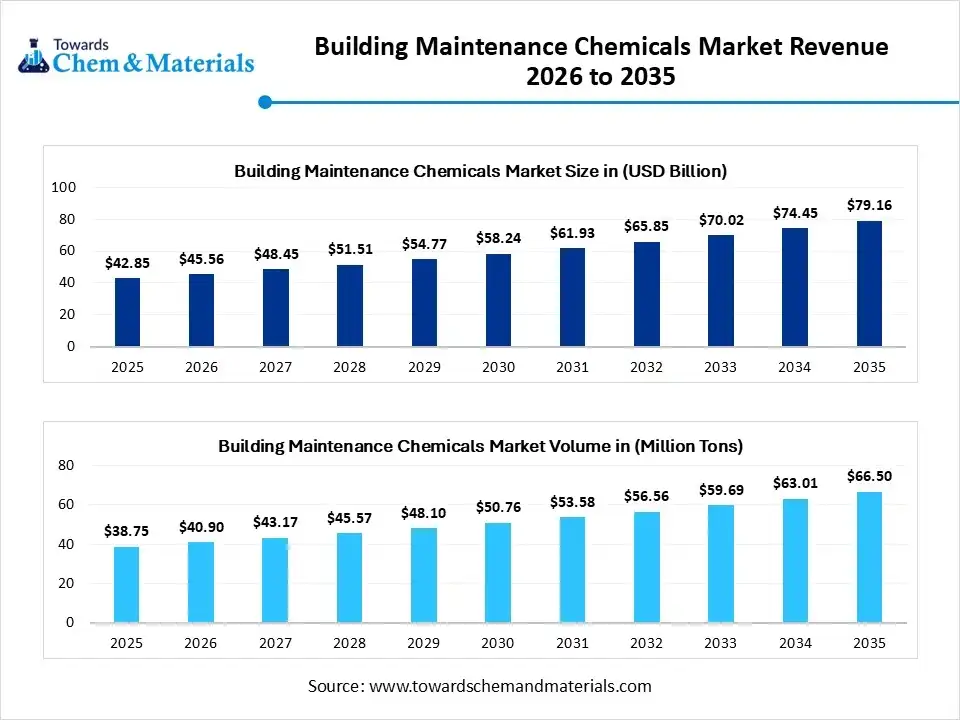
The global Building Maintenance Chemicals market was valued at USD 42.85 billion in 2025, is estimated to reach USD 45.56 billion in 2026, and is projected to reach USD 79.16 billion by 2035, growing at a CAGR of 6.33% from 2026 to 2035. In terms of volume, the Building Maintenance Chemicals market is projected to grow from 38.75 million tons in 2025 to 66.50 million tons by 2035. growing at a CAGR of 5.55% from 2026 to 2035. Increasing demand for high-performance concrete materials is the key factor driving market growth. Also, ongoing urbanisation coupled with the infrastructure expansion can fuel market growth further.
Key Takeaways
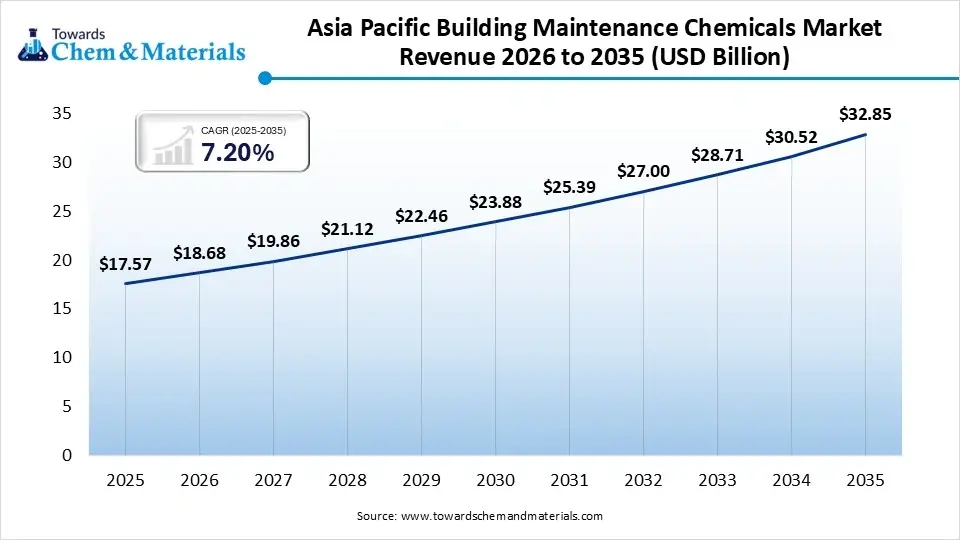
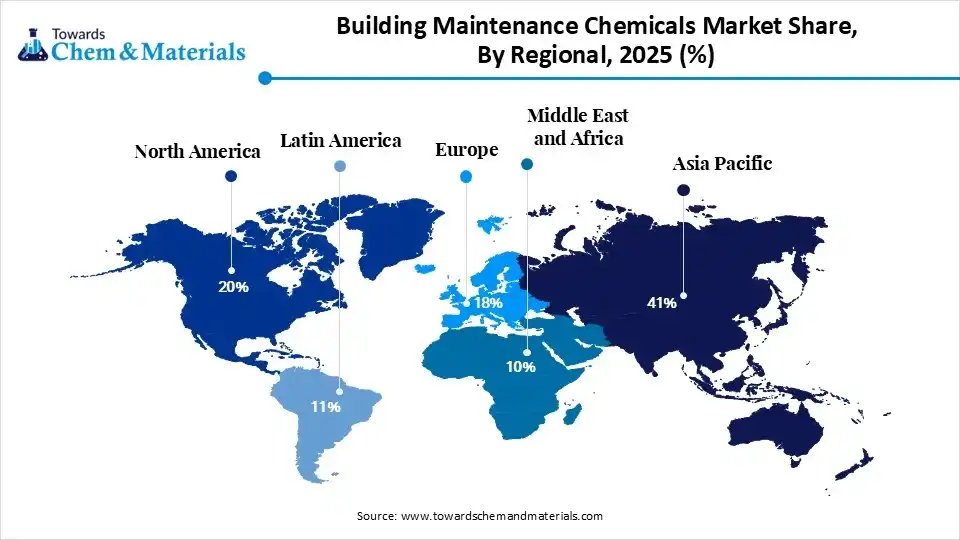
- By region, Asia Pacific dominated the market with the largest share of 41% in 2025 and is expected to grow at the fastest CAGR of 7.1 % over the forecast period.
- By region, North America held the market share of 20% in 2025.
- By product type, the cleaning chemicals segment dominated the market with the largest share of 34% in 2025.
- By product type, the dishwashing chemicals segment is expected to grow at the fastest CAGR of 6.6% over the forecast period.
- By application, the residential buildings segment dominated the market with the largest share of 36% in 2025.
- By application, the institutional segment is expected to grow at the fastest CAGR of 6.8% over the forecast period.
- By end-use industry, the facility management services segment dominated the market with the largest share of 29% in 2025.
- By end-use industry, the healthcare sector segment is expected to grow at the fastest CAGR of 7.1% over the forecast period.
- By form, the liquid segment dominated the market with the largest share of 48% in 2025 and is expected to grow at the fastest CAGR of 6.7% during the projected period.
- By distribution channel, the distributors & wholesalers segment dominated the market with the largest share of 34% in 2025.
- By distribution channel, the online retail segment is expected to grow at the fastest CAGR of 7.2% during the study period.
Building Maintenance Chemicals Market Size and Forecast
- Market Estimated Size (2025): USD 42.85 Billion | CAGR (2026–2035): 6.33%
- Market Projected Size (2035): USD 79.16 Billion
- Market Volume (2025): 38.75 Million Tons | Volume CAGR (2026–2035):5.55%
- Market Projected Volume (2035): 66.50 Million Tons
- Market Pricing (2025):
- Average Manufacturing Price (2025): USD 730 per ton
- Average Selling Price (2025): USD 1,060 per ton
- Pricing CAGR (2025–2035): 3.15%
What are Building Maintenance Chemicals Market?
The market encompasses specialized products such as coatings, sealants, cleaners, and repair agents used to safeguard, repair, and clean commercial, residential, and industrial structures. The market is rapidly transitioning towards smart and sustainable technologies like self-healing concrete to minimize long-term maintenance costs.
Recent Market Trends
- Surged demand for sustainable construction solutions is the latest trend in the market, shaping positive market growth. Construction projects are rapidly seeking low-VOC and sustainable chemical solutions that fulfil specific regulatory and environmental requirements.
- The market is experiencing a rise in demand for high-performance materials that improve structural longevity. Industries including residential, infrastructure, and commercial construction need significant material strength to bear environmental stresses and increase service life.
- The rapid transition towards long-term surface protection is another major trend driving market growth. Commercial and industrial buildings are heavily specified with innovative polyurethane and epoxy protective coating to ensure long-term durability against mechanical equipment, high foot traffic, and chemical spills.
Report Scope
| Report Attribute | Details |
| Market Size and Volume in 2026 | USD 45.56 Billion / 40.90 Million Tons |
| Revenue Size and Volume Forecast in 2035 | USD 79.16 Billion / 66.50 Million Tons |
| Growth Rate | CAGR 6.33% |
| Forecast Period | 2026 - 2035 |
| Base Year | 2025 |
| Dominant Region | Asia Pacific |
| Segment Covered | By Grade, By Application, By Processing Technology, By Regions |
| Key companies profiled | BASF SE, Dow Inc., Henkel AG & Co. KGaA, Ecolab Inc., and Pidilite Industries, along with specialized entities like Borealis AG and Braskem |
How Cutting-Edge Technologies Are Revolutionizing the Building Maintenance Chemicals Market?
Advanced technologies are transforming the market by transitioning the industry from reactive repairs to data-driven, proactive, and sustainable solutions. Furthermore, digital tools are facilitating supply chains, improving product formulation research, and allowing robots to help in exterior cleaning, particularly on high-rise structures.
Supply Chain Analysis of the Building Maintenance Chemicals Market
Feedstock Procurement
- It involves the sourcing, negotiation, and acquisition of essential materials required to produce cleaning, protective, and repair chemicals for residential and commercial structures.
- Major Players: BASF SE, Dow Inc
Chemical Synthesis and Processing
- It involves the industrial-scale design and modification of chemical compounds to enhance, protect, and repair building materials.
- Major Players: Henkel AG & Co. KGaA, Dow Inc.
Packaging and Labelling
- It refers to the processes and regulations used to enclose, identify, and transport cleaning and maintenance chemicals, as these products contain active ingredients and agents.
- Major Players: Ecolab Inc., Clariant AG
Regulatory Compliance and Safety Monitoring
- It ensures that products meet the legal, environmental, and occupational framework. It involves hazardous waste management to prevent risks and legal violations.
- Major Players: Arkema SA, Pidilite Industries
Building Maintenance Chemicals Market's Regulatory Landscape: Global Regulations
| Country/Region | Key Regulations |
| United States | A voluntary EPA program that certifies high-performance cleaning and maintenance chemicals that meet strict safety and ecological criteria. |
| European Union | Green Deal & Eco-Label: Promotes the phase-out of Persistent, Bioaccumulative, and Toxic (PBT) substances, accelerating the adoption of bio-based surfactants and sustainable industrial cleaners |
| China | PFAS Bans: Stricter measures aligned with international treaties (such as the Stockholm Convention) have restricted the use of forever chemicals in specialty surface coatings. |
Market Dynamics
Driver
The growing emphasis on green building practices is the major factor driving market growth. Cutting-edge construction chemicals give improved environmental benefits, such as less carbon footprint and low-VOC formulations, which are convenient to developers concerned about environmental impact.
Restraints
High Raw Material Prices
The prices of essential raw materials like solvents, surfactants, and phosphates are generally susceptible to fluctuations in geopolitical tensions and crude oil prices, which are the major factors hindering market growth. Moreover, this volatility directly affects the manufacturing costs for market players, narrowing profit margins.
Opportunity
Growth of Smart Cities
The ongoing expansion of smart cities and mega-infrastructure projects across the globe is creating lucrative opportunities in the market. As the government is heavily investing in large-scale infrastructure projects such as energy facilities, transportation networks, and urban renewal projects, the demand for innovative construction materials is increasing.
Segmental Insights
Product Type Insights
The Cleaning Chemicals Segment Dominated the Market with 34% of Market Share in 2025
The cleaning chemicals segment dominated the market with the largest share of 34% in 2025. The dominance of the segment can be attributed to the increasing hygiene standards across the commercial and residential sectors, along with the growth in urban households. Also, frequent cleaning cycles increase product consumption further.
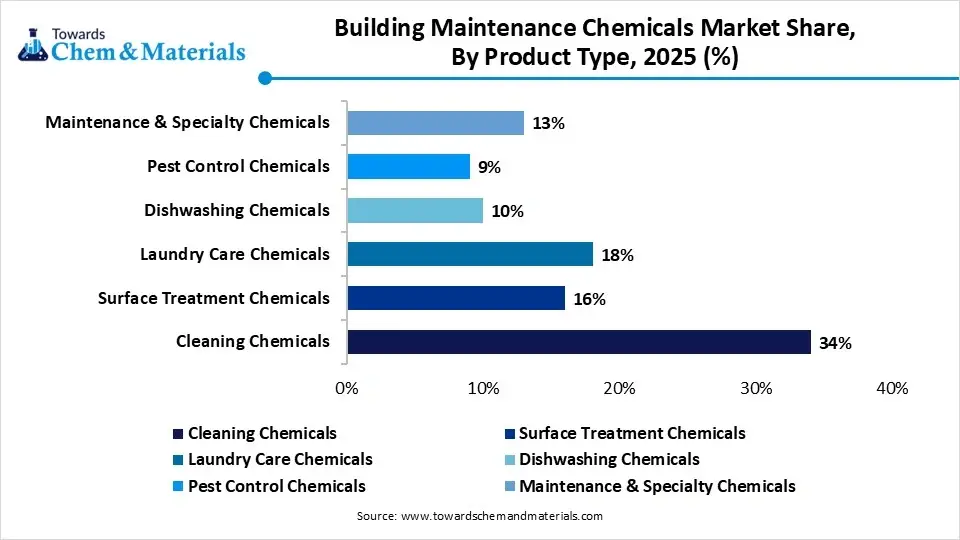
The dishwashing chemicals segment held the market share of 10% and is expected to grow at the fastest CAGR of 6.6% over the forecast period. The growth of the segment can be credited to the increasing demand for convenience food products and the growing adoption of automatic dishwashers globally. Commercial kitchens fuel bulk consumption.
The laundry care chemicals segment held the market share of 18% in 2025. The growth of the segment can be linked to the expanding hospital and healthcare sectors, coupled with the ongoing innovations in detergent formulations. High consumption in institutional cleaning services will drive segment growth shortly.
Application Insights
The Residential Buildings Segment Dominated the Building Maintenance Chemicals Market with 36% of Market Share in 2025
The residential buildings segment dominated the market with the largest share of 36% in 2025. The dominance of the segment can be driven by increasing disposable incomes, which boost the adoption of premium products and a surge in urban households. Regula's maintainer needs to sustain demand.
The institutional segment held the market share of 19% in 2025 and is expected to grow at the fastest CAGR of 6.8% over the forecast period. The growth of the segment is owing to the increasing product demand from hospitals and schools, and the surge in public infrastructure projects. Government regulations also support sanitation practises.
The commercial buildings segment held the market share of 27% in 2025. The growth of the segment is due to expansion in offices and retail spaces, along with the growing demand for professional maintenance services. Surge in emphasis on hygiene standards propels consumption shortly.
End-Use Industry Insights
The Facility Management Services Segment Dominated the Market with 29% of Market Share in 2025
The facility management services segment dominated the market with the largest share of 29% in 2025. The dominance of the segment can be attributed to the growth in smart building initiatives and increasing demand for high-performance disinfectants. Stringent infection control protocols increase chemical usage.
The healthcare sector segment held the market share of 17% in 2025 and is expected to grow at the fastest CAGR of 7.1% over the forecast period. The growth of the segment can be credited to the growth in healthcare infrastructure and increasing chemical consumption from outsourcing facilities. Growing tourism boosts demand further.
The industrial sector segment held the market share of 22% in 2025. The growth of the segment can be linked to the increasing need for heavy-duty cleansing chemicals for industrial applications and the rising demand for machinery maintenance. Safety regulations support chemical usage.
Form Insights
The Liquid Segment Dominated the Market with 48% of Market Share in 2025
The liquid segment dominated the market with the largest share of 48% in 2025 and is expected to grow at the fastest CAGR of 6.7% during the projected period. The dominance and growth of the segment can be driven by its extensive use across cleaning and disinfectant products, along with its compatibility with automated systems. Easy applications and quick actions boost preference further.
The powder segment held the market share of 22% in 2025. The growth of the segment is owing to its long shelf life and cost-effectiveness, coupled with the growing use in bulk institutional cleaning. It is also suitable for storage and transport.
The spray segment held the market share of 18% in 2025. The growth of the segment is due to the growth in ready-to-use food products and the growing popularity of household and cleaning applications. Convenience and targeted application further increase usage.
Distribution Channel Insights
The Distributors & Wholesalers Segment Dominated the Market with 34% of Market Share in 2025
The distributors & wholesalers segment dominated the market with the largest share of 34% in 2025. The dominance of the segment can be attributed to the strong market presence in emerging markets and increasing demand for bulk supply from the commercial and industrial sectors. A wide network ensures product availability.
The online retail segment held the market share of 16% in 2025 and is expected to grow at the fastest CAGR of 7.2% during the study period. The growth of the segment can be credited to the rapid growth of the e-commerce industry and increasing digital adoption. The convenience of home delivery will impact positive market growth soon.
The direct sales segment held the market share of 26%in 2025. The growth of the segment can be driven by its ability to provide customized solutions and strong relationships with facility managers. Large contracts with commercial clients fuel segment growth further.
The supermarkets/hypermarkets segment held the market share of 24% in 2025. The growth of the segment can be driven by strong retail presence in emerging nations and easy availability, attracting various consumers. Promotions and discounts will initiate propelling segment growth shortly.
Regional Insights
How did Asia Pacific Dominate the Building Maintenance Chemicals Market in 2025?
Asia Pacific dominated the market with the largest share of 41% in 2025 and is expected to grow at the fastest CAGR of 7.1 % over the forecast period. The dominance and growth of the region can be attributed to the ongoing urbanisation and expansion of commercial infrastructure in emerging economies. In addition, major market players in the region are increasingly investing in retrofitting, repair, and specialized maintenance to expand the lifecycle of existing facilities.
China Building Maintenance Chemicals Market Trends
In the Asia Pacific, China dominated the market owing to the growth in renovation projects for aging infrastructure, along with the substantial government investments in infrastructure. Also, growing demand for high-performance chemicals, such as innovative waterproofing and protective treatments, fuels R&D efforts among major players.
North America Building Maintenance Chemicals Market Trends
North America held the market share of 20% in 2025. The growth of the region can be credited to the increasing adoption of high hygiene standards, coupled with the growing adoption of innovative cleaning technologies. Furthermore, there is a growing transition towards biodegradable and green building materials, boosted by rising environmental awareness among consumers.
U.S. Building Maintenance Chemicals Market Trends
The growth of the market in the country is due to the increasing need for specialized disinfectants in commercial sectors, along with the substantial investment in renovation and construction projects. Moreover, the expansion in hospitals, healthcare, and food processing facilities has fuelled demand for cutting-edge disinfectants and sanitizers.
Recent Development
In February 2026, Rehab Technologies announced the launch of RBN (Repairing Buildings Nationally), a strategic initiative designed to address the escalating crisis of ageing infrastructure across India. Spearheaded by Dr. P. Srinivasa Reddy, CEO of Rehab Technologies and Public Policy Advisor, RBN is proposed as a national mission aimed at systematically repairing deteriorating structures and enhancing public safety.(Source: www.rprealtyplus.com)
Building Maintenance Chemicals Market Companies
- BASF: BASF is a major player in the global building materials and maintenance chemicals market, providing a broad range of high-performance polymers, additives, and specialized chemical solutions.
- The Dow Chemical Company: The Dow Chemical Company (a subsidiary of Dow Inc.) is a global leader in materials science, providing a vast portfolio of chemicals essential to building construction, maintenance, and repair, with a strong focus on sustainability and high-performance, long-lasting solutions.
Other Companies in the Market
Segments Covered in the Report
By Product Type
- Cleaning Chemicals
- General Purpose Cleaners
- Floor Cleaners
- Neutral Floor Cleaners
- Heavy-Duty Floor Cleaners
- Glass Cleaners
- Disinfectants & Sanitizers
- Surface Disinfectants
- Air Disinfectants
- Surface Treatment Chemicals
- Polishes
- Floor Polish
- Metal Polish
- Sealers
- Protective Coatings
- Polishes
- Laundry Care Chemicals
- Detergents
- Powder Detergents
- Liquid Detergents
- Fabric Softeners
- Bleaching Agents
- Detergents
- Dishwashing Chemicals
- Manual Dishwashing Liquids
- Machine Dishwashing Detergents
- Pest Control Chemicals
- Insecticides
- Rodenticides
- Repellents
- Maintenance & Specialty Chemicals
- Descalers
- Degreasers
- Odor Control Agents
By Application
- Residential Buildings
- Apartments
- Individual Houses
- Commercial Buildings
- Offices
- Retail Spaces
- Hospitality
- Industrial Facilities
- Manufacturing Plants
- Warehouses
- Institutional
- Hospitals
- Educational Institutions
- Government Buildings
By End-Use Industry
- Facility Management Services
- Hospitality Industry
- Healthcare Sector
- Retail Sector
- Industrial Sector
By Form
- Liquid
- Powder
- Spray
- Gel
By Distribution Channel
- Direct Sales
- Distributors & Wholesalers
- Online Retail
- Supermarkets/Hypermarkets
By Regions
- North America
- U.S.
- Canada
- Mexico
- Europe
- Germany
- UK
- France
- Italy
- Spain
- Asia Pacific
- China
- India
- Japan
- South Korea
- Latin America
- Brazil
- Argentina
- Middle East & Africa
- Saudi Arabia
- South Africa
FAQ's
Question 1 : What is the projected market size and growth rate for the Building Maintenance Chemicals industry?
Answer : The global Building Maintenance Chemicals market is projected to reach USD 79.16 billion by 2035, growing at a CAGR of 6.33% from its 2026 estimated value of USD 45.56 billion.
Question 2 : Which product segment and region currently dominate the Building Maintenance Chemicals market?
Answer : The cleaning chemicals segment leads the market with a 34% share, while the Asia Pacific region holds the largest geographic share at 41%, driven by rapid urbanization and infrastructure expansion in emerging economies.
Question 3 : Who are the key players and manufacturers in the Building Maintenance Chemicals market?
Answer : The global supply chain is led by major chemical manufacturers including BASF SE, Dow Inc., Henkel AG & Co. KGaA, Ecolab Inc., and Pidilite Industries, along with specialized entities like Borealis AG and Braskem.
Question 4 : What are building maintenance chemicals used for?
Answer : These are specialized products like cleaners, sealants, protective coatings, and repair agents. They are used to clean surfaces, protect structures from weather or mechanical damage, and repair minor issues in residential, commercial, and industrial buildings.
Question 5 : Why is the Asia Pacific region leading this market?
Answer : Asia Pacific has the world\'s fastest-growing cities and a massive volume of new construction. Countries like India and China are investing heavily in infrastructure and urban renewal, which creates a huge, ongoing need for maintenance and protection chemicals.
Meet the Team

Saurabh Bidwai
Principal Consultant
Saurabh Bidwai, a B.Tech Chemical Engineering graduate with 4+ years of experience, specializes in specialty chemicals, commodity chemicals, and engineered materials, offering valuable insights into market trends and emerging opportunities.

Aditi Shivarkar
Reviewed By
Aditi Shivarkar, with 14+ years in Chemical and Materials market research, specializes in Chemical and Materials. She ensures accurate, actionable insights, driving Towards Chemicals And Materials Analytics and Consulting excellence in industry trends and sustainability.