
U.S. Natural Gas Market Size, Share, Growth, Report 2026 to 2035
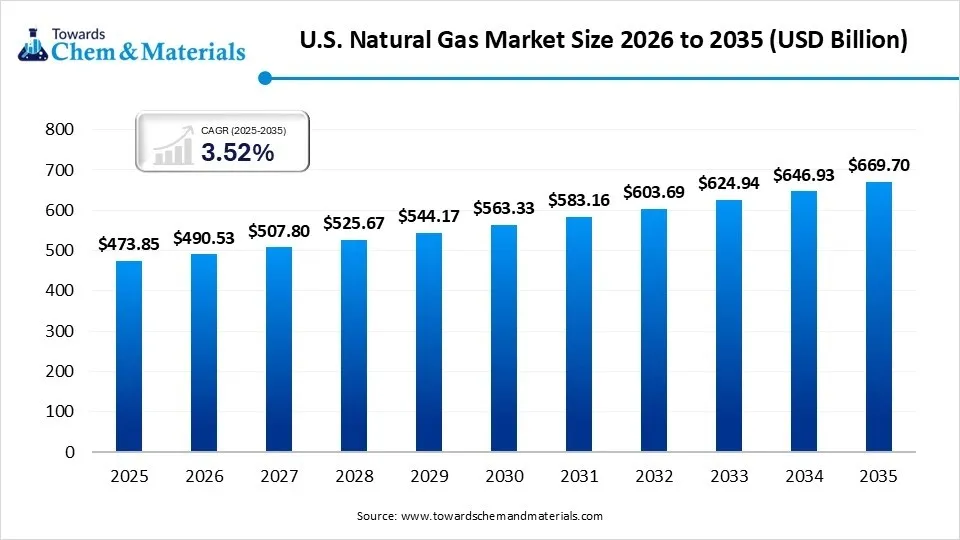
The U.S. natural gas market size is expected to grow from USD 490.53 billion in 2026 to USD 669.70 billion in 2035, growing at a CAGR of 3.52% from 2026 to 2035. The top key players in the market are ExxonMobil Corporation, Chevron Corporation, ConocoPhillips, Hess Corporation, TotalEnergies SE, Southwestern Energy, EOG Resources, Inc., Occidental Petroleum Corporation, Hess Corporation, and Cheniere Energy-Global Forecast 2026 To 2035
Content
What is the Current Size of the U.S. Natural Gas Market and Its Projected Growth?
The U.S. natural gas market size was estimated at USD 473.85 billion in 2025 and is expected to increase from USD 490.53 billion in 2026 to USD 669.70 billion by 2035, growing at a CAGR of 3.52% from 2026 to 2035. The market is driven by its shale revolution, the expansion of LNG and decarbonization infrastructure, and technological advancements in the region.
Market Highlights
- By gas type, the methane segment held the largest share in the market in 2025 due to its combustible properties and the U.S. shift towards environmental transparency.
- By gas type, the ethane segment is expected to grow at the fastest CAGR during the forecast period due to regional transformation and its petrochemical demand.
- By source, the unconventional gas segment dominated the market, driven by its permanent structural abundance and domestic innovation for export arbitrage.
- By source, the conventional segment is expected to grow at the fastest CAGR in the market during the forecast period due to U.S. high-permeability reservoirs and supply stability.
- By application, the electric power segment dominated the market due to regional shift towards modern energy and decarbonization commitment.
- By application, the industrial segment is anticipated to grow at the fastest CAGR in the market during the forecast period due to its U.S. chemical feedstock abundance and rising focus on domestic production.
Market Overview
The U.S. natural gas market is represented by its hyper-liquid standards and a shale-driven industry that has transformed the energy framework. The United States' structural abundance, combined with technological advances in extraction, shifted from insufficiency to a major export engine. The natural gas provides dispatchable thermal power to stabilise renewable intermittency, ensuring grid resilience.
The U.S. domestic economic infrastructure includes Henry Hub indexing and basis differentials, which promote theoretical trading and risk mitigation at the regional and international level. The expanding LNG infrastructure connects U.S. production to international demand and geopolitics, positioning the region as vital for global energy diplomacy.
Report Scope
| Report Attribute | Details |
| Market Size in 2026 | USD 490.53 Billion |
| Revenue Forecast in 2035 | USD 669.70 Billion |
| Growth Rate | CAGR 3.52% |
| Forecast Period | 2026 - 2035 |
| Base Year | 2025 |
| Segment Covered | By Gas Type, By Source, By Application, |
| Key companies profiled | ExxonMobil Corporation, Chevron Corporation, ConocoPhillips, Hess Corporation, TotalEnergies SE, Southwestern Energy, EOG Resources, Inc., Occidental Petroleum Corporation, Hess Corporation, and Cheniere Energy |
U.S. Natural Gas Market Dynamics
Market Drivers
- Technological Dominance and Shale Revolution: The refinement of horizontal drilling and high-intensity hydraulic fracturing acts as a key pillar for structural integrity, maintaining U.S. leadership in the global supply and production powerhouse.
- Wide-Spread Export Expansion: The production of liquefied natural gas terminals transforms domestic gas into a globally connected network that drives U.S. to international demand shocks and a tool of geopolitical influence.
- Feedstock Abundance: The region is the foundation of an industrial feedstock low-cost environment generated by domestic production, which acts as an economic multiplier that accelerates the growth in U.S.-based energy-intensive sectors like petrochemicals, agrochemicals, and steel manufacturing.
Market Restraints
- Midstream blocks and Litigation Risks: The regulatory pressure and permitting delays surrounding new pipeline construction limit the ability to shift gas from prolific shale plays to high-demand coastal hubs and urban hubs.
- Environmental Analysis and Methane Intensity: Intensifying federal and state regulatory compliance regarding emissions and methane leaks initiates the adoption of costly leak detection and repair protocols and an advanced satellite monitoring system.
- Structural Price Volatility: The U.S. market is highly sensitive to extreme climate-driven demand and geopolitical instability, which enables complex basis differentials and unpredictable future term structure that challenges long-term planning.
Market Opportunity
- Certified and Responsibly Sourced Gas: The market is emerging towards a premium tier for low-methane intensity. The opportunity enables blockchain-based transparency and continuous monitoring technologies for environmentally conscious domestic utilities seeking to meet strict ESG mandates.
- The Blue Hydrogen and Ammonia Economy: The R&D project in the United States is a foundational feedstock for low-carbon hydrogen manufacturing that integrates with carbon capture and sequestration, which allows the domestic sector to move towards clean energy carrier supply in chemical production and heavy-duty transportation.
- Virtual Pipeline and Micro-LNG Solution: The rising opportunity in decentralized energy delivery, where small-scale liquefaction and modular compressors enable natural gas to serve as marine bunkering fuel in the transportation sector.
Key Technological Shifts and AI in the U.S. Natural Gas Market
Technological advancement and AI are key drivers of the U.S. natural gas market, which is facilitating a data-centric energy ecosystem with operational precision. The integration of machine learning and predictive analytics optimize reservoir management and shale-well output through an autonomous drilling database. In midstream and downstream sectors, AI offer engine reliability and leak detection using advanced sensors and satellite monitoring.
The U.S. is at the forefront of technological innovation, supported by a financial ecosystem that is driving algorithmic forecasting and digital twins to improve logistics and risk management in the face of global price volatility. The rising focus on environmental transparency that technological shift enables with blockchain-based carbon tracking and AI emissions reviewing is prominent for certified gas exports and investor-driven sustainability mandates.
U.S. Natural Gas Market: Supply Chain Analysis
- Extraction and Exploration: The initial stage where U.S. manufacturers focus on identification, drilling and recovery of natural gas from unconventional shale and reservoirs. In this stage, researchers focus on improving wellbore productivity, reducing marginal breakeven costs and adopting methane intensity monitoring to manufacture certified gas.
- Key Players: ExxonMobil, Chevron, EQT Corporation, Chesapeake Energy, Coterra Energy, Southwestern Energy
- Processing and Logistics: The stage is a key pillar of logistics that gathers, high-pressure transmission and fractionation of raw gas that transforms into pipeline-quality methane and valuable natural gas liquids by offering system reliability and pipeline integrity using AI-driven predictive maintenance and underground storage facilities.
- Key Players: Kinder Morgan, The Williams Companies, Enterprise Products Partners, Energy Transfer, and Enbridge.
- End-Use Integration and Export: The key stage involves monetization and distribution of processed commodities to the domestic market, where this stage has undergone globalized transformation, with the U.S. being an export powerhouse that is bridging the gap to international arbitrage using advanced liquefaction infrastructure.
- Key Players: Cheniere Energy, Sempra Infrastructure, Freeport LNG, Southern Company and Consolidated Edison.
Regulatory Framework: U.S. Natural Gas Market
| Key Regulations | Regulatory Focus |
| Bifurcated Jurisdictional Mandates | Strict limitation between federal authority over high-capacity interstate commerce and state-level integrity regarding wellhead extraction, local utility logistics and drilling permit issuance |
| Federal Energy Regulatory Commission | The economic and siting regulatory to grant certificates of public convenience and necessity for the construction of an interstate pipeline network and coastal LNG export terminals |
| The Natural Gas Act Framework | The legislative pillar that decides pricing and prohibits undue preference in the transportation and sale of natural gas across state lines. |
| The Clean Air Act | A key tool for environmental enforcement aimed at methane intensity standards, fugitive emission mitigation and demand adoption of leak detection and repair (LDAR) protocols. |
| Market Integrity and Anti-Manipulation | Post-deregulation innovation emphasises the Energy Policy Act in strengthening regulators to maintain price transparency, castigate algorithmic market abuse, and protect the liquidity of Henry Hub standards. |
| Department of Energy (DOE) Export Control | The evaluation of public interest determination for liquefied natural gas exports that balances domestic supply-demand equilibrium and price stability with the demands of global energy diplomacy. |
| Environmental Enforcement (EPA) | The act enforces methane emissions standards to lower the leaks from new and established sources that lead to the development of a waste emission charge rule for federal methane fee filings. |
| Evolving Permitting and NEPA Reviews | The National Environmental Policy Act acts as a key hurdle to comprehensive climate impact assessment and litigation-prone permitting cycles that create midstream infrastructure bottlenecks. |
| Certified Gas and ESG Standardization | The regulatory focus is driving the shift towards responsibly sourced gas, where manufacturers and researchers are integrating third-party verification and blockchain-enabled carbon accounting in reporting. |
| State-Level Commissions | The research monitors the Texas Railroad Commission and the Pennsylvania PUC, which regulates intrastate transport, wellbore integrity, mineral rights and retail rate-setting for industrial and residential consumers. |
| Pipeline Safety (PHMSA) | The Pipeline and Hazardous Materials Safety Administration mandates safety for pipeline design and underground storage integrity for salt caverns and depleted reservoirs, effective at the end of 2025. |
Segmental Insights
Gas Type Insights
Methane Segment Led the U.S. Natural Gas Market in 2025 with the Largest Share
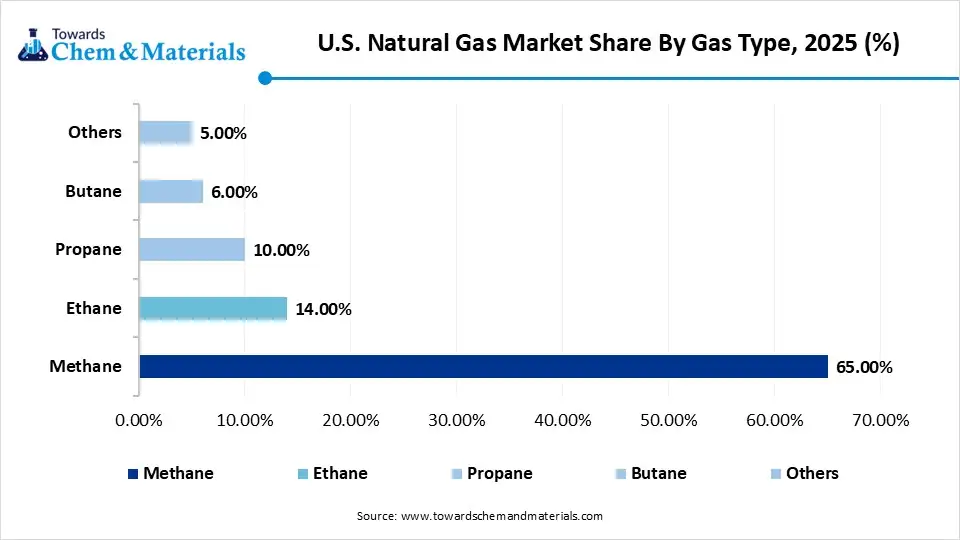
Methane segment dominated the market share 65.00% in 2025, serving as the main hydrocarbon and energy asset that defines the industry’s value, serving as the core fuel for power burn and heavy industry. Methane, as a combustible molecule of dry gas stream, requires extensive processing to reach pipeline purity for domestic logistics. The segment is increasingly redefined by environmental transparency, where methane emissions and leaks influence premium pricing and export potential within the LNG supply chain in the U.S. market.
The ethane segment is the fastest-growing in the market during the forecast period, acting as a key for premium natural gas liquids and a petrochemical building block. The ethane is the lightest purity product extracted from wet gas streams for ethylene production and steam cracking. The segment's ability to show operational duality, where value fluctuates, is recovered as a raw material or burned for fuel. Ethane is an inducer of share-based abundance in the U.S. that transforms it from a byproduct into a global trade asset. Additionally, the rising focus on logistical integration of ethane has positioned the United States as a pillar of chemical manufacturing.
U.S. Natural Gas Market Share By Gas Type, 2025 (%)
| By Gas Type | Revenue Share, 2025 (%) |
| Methane | 65.00% |
| Ethane | 14.00% |
| Propane | 10.00% |
| Butane | 6.00% |
| Others | 5.00% |
- Methane dominates due to its widespread use as the primary fuel in natural gas consumption, powering electricity generation, heating, and industrial applications with 65.00% in 2025.
- Ethane : Gains momentum as a crucial feedstock for petrochemical production, particularly in ethylene manufacturing, benefiting from growing demand in the chemical industry with 14.00% in 2025.
- Propane : Remains stable with its significant role in residential heating, cooking, and as an industrial fuel, but is overshadowed by methane's larger share in energy consumption with 10.00% in 2025.
- Butane : Holds a smaller share primarily used in liquefied petroleum gas (LPG) for portable applications and blending in gasoline, with limited growth compared to methane and ethane with 6.00% in 2025.
- Others Represents a diverse group of gases used in specialized applications, showing minor dominance due to the niche nature of their uses across various industries with 5.00% in 2025.
Source Insights
Unconventional Segment Dominated the U.S. Natural Gas Market in 2025 with the Largest Share
Unconventional segment led the market share 81.00% in 2025, driven by the transition from terminal depletion to permanent structural abundance. The source involving shale and tight gas has transformed the U.S. from depletion to abundance through advanced drilling and hydraulic fracturing. The segment is known as high-intensity capital assets that enable operational efficiency and technological innovation. The U.S. is focusing on curve management, scalability, and resource density, which is boosting the domestic market expansion towards global demand shocks and international export arbitrage.
The conventional segment is experiencing the fastest growth in the market during the forecast period. Because it acts as a legacy and heritage pillars that rely on high-permeability reservoirs and simple extraction. The segment is distinguished by its prolonged production plateau and stable decline curve that foster a low-volatility resource base and predictability. The conventional source value for U.S. supply stability and integrated reservoir management is providing a stable, long-term supply. The rising innovation in the U.S. focuses on the operational longevity of natural gas and the potential for repurposing into CCS and hydrogen storage infrastructure.
U.S. Natural Gas Market Share By Source, 2025 (%)
| By Source | Revenue Share, 2025 (%) |
| Conventional | 19.00% |
| Unconventional | 81.00% |
- Conventional accounts for 19.00% in 2025, as traditional natural gas extraction methods continue to contribute a smaller share compared to more modern techniques.
- Unconventional dominates with 81.00% in 2025, driven by advancements in hydraulic fracturing and horizontal drilling, allowing access to previously untapped shale gas reserves.
Application Insights
The Electric Power Segment Led the U.S. Natural Gas Market in 2025 with the Largest Share
The electric power segment dominated the market share 41.00% in 2025, driving the modern energy transition. The segment plays a key role in power generation with natural gas as a flexible, efficient backup to renewable resources. The U.S. massive structural coal-to-gas transition offers high thermal stability and operational reliability integrated with combined-cycle gas turbine technology. The segment supporting grid stability and decarbonization efforts through technological shift and long-term net-zero sustainability goals.
The industrial segment is anticipated to grow fastest in the market during the forecast period, due to rising demand for natural gas for thermal energy and the chemical industry. The segment is a key economic multiplier for domestic manufacturing expansion. Natural gas is vital for sectors like petrochemicals, steel, and fertilizers where the U.S. provides chemical feedstock derived from its shale-driven cost advantage. As manufacturers become demand-sensitive, with a focus on certification of low-carbon gas and CCS to sustain industrial productivity and meet sustainability goals, boosting the macroeconomic health of the United States market.
U.S. Natural Gas Market Share By Application, 2025 (%)
| By Application | Revenue Share, 2025 (%) |
| Residential | 16.00% |
| Commercial | 12.00% |
| Electric Power | 41.00% |
| Industrial | 26.00% |
| Others | 5.00% |
- Residential accounts for 16.00% in 2025, driven by natural gas usage for heating, cooking, and water heating in homes.
- Commercial holds 12.00% in 2025, primarily used for heating, cooling, and powering businesses and public facilities.
- Electric Power dominates with 41.00% in 2025, as natural gas remains a primary fuel for electricity generation due to its efficiency and lower emissions compared to coal.
- Industrial accounts for 26.00% in 2025, driven by natural gas usage in manufacturing processes, chemical production, and various heavy industries.
- Others represent a smaller share of 5.00% in 2025, attributed to specialized uses in sectors like transportation and petrochemical applications.
Recent Developments
- In January 2026, Baker Hughes recently announced a multi-year agreement with Expand Energy to deploy Leucipa™, the automated field production solution. The strategic partnership uses AI to optimize gas-producing wells in the United States.(Source: www.bakerhughes.com )
- In January 2025, Chevron's strategic collaboration with Engine No. 1 and GE Vernova to develop a new, reliable power solution for U.S. based data centers. The joint development focuses on building first power foundries and delivering up to multi-gigawatt-scale co-located power plants.(Source: www.chevron.com)
Market Top Companies and Their Offerings
- Expand Energy: The largest natural gas producers in the United States that offer high-volume hydrocarbon extraction from shales. The player's portfolio includes certified low-methane gas and advanced AI-driven reservoir management in real-time.
- Kinder Morgan: The nation's biggest natural gas network that offers interstate pipeline capacity and diversified underground storage solutions in reservoirs and salt caverns of all U.S. LNF export facilities, ensuring steady flow for global trade.
- Cheniere Energy: The U.S. exporter that offers full-scale liquefaction of natural gas and regasification services. Their core product is seaborne LNG provide using flexible, long-term contracts to prevent regional price volatility.
- Atmos Energy: The largest pure-natural gas utility provider that offers last-mile distribution services and domestic storage for residential and industrial customers, which focuses on replacing legacy distribution maintenance through infrastructure modernization programs.
- EQT Corporation: The key players offer vertically integrated manufacturing, midstream services, and utility-scale natural gas supply that allow them to market domestic gas into Europe and Asia pacific buyers using contracted
- LNG capacity.
- ExxonMobil Corporation
- Chevron Corporation
- ConocoPhillips
- EOG Resources, Inc.
- Occidental Petroleum Corporation
- Hess Corporation
- Devon Energy Corporation
- Pioneer Natural Resources
- Southwestern Energy
- TotalEnergies SE
- Others
Segment Covered in the Report
By Gas Type
- Ethane
- Propane
- Methane
- Butane
- Others
By Source
- Conventional
- Unconventional
By Application
- Residential
- Commercial
- Electric Power
- Industrial
- Others
FAQ's
Question 1 : What is the projected growth of the U.S. Natural Gas market from 2025 to 2035?
Answer : The U.S. Natural Gas market is expected to grow at a CAGR of 3.52%, from USD 490.53 billion in 2026 to USD 669.70 billion by 2035.
Question 2 : How is the shale revolution impacting the U.S. Natural Gas market?
Answer : The shale revolution has transformed the U.S. into a major natural gas producer, with advanced extraction technologies and hydraulic fracturing driving abundant domestic supply and export opportunities.
Question 3 : Which segment dominates the U.S. Natural Gas market by application?
Answer : The electric power segment leads the U.S. Natural Gas market, driven by the transition to modern energy, where natural gas supports grid stability and decarbonization efforts.
Question 4 : Who are the key players in the U.S. Natural Gas market?
Answer : Key players include ExxonMobil, Chevron, ConocoPhillips, EOG Resources, Kinder Morgan, and Cheniere Energy, among others.
Meet the Team

Saurabh Bidwai
Principal Consultant
Saurabh Bidwai, a B.Tech Chemical Engineering graduate with 4+ years of experience, specializes in specialty chemicals, commodity chemicals, and engineered materials, offering valuable insights into market trends and emerging opportunities.

Aditi Shivarkar
Reviewed By
Aditi Shivarkar, with 14+ years in Chemical and Materials market research, specializes in Chemical and Materials. She ensures accurate, actionable insights, driving Towards Chemicals And Materials Analytics and Consulting excellence in industry trends and sustainability.